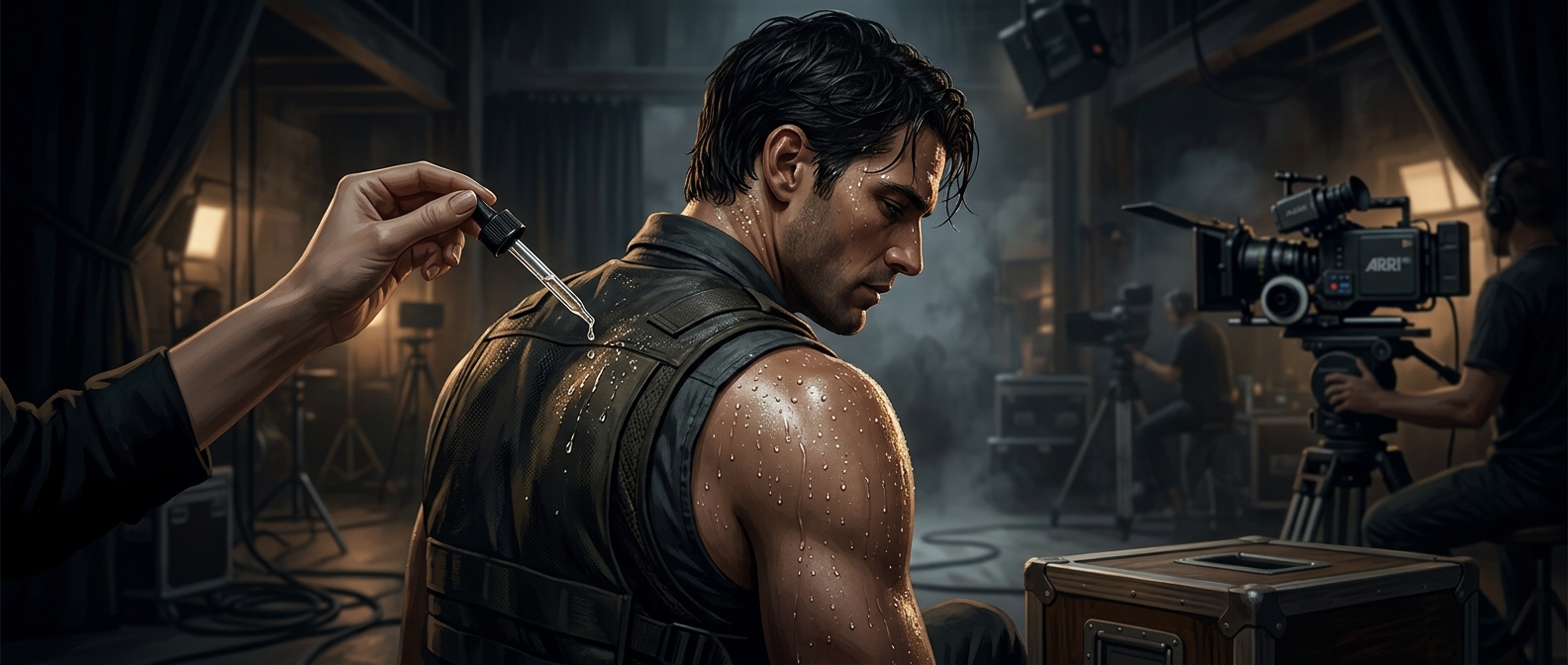
Why a Water-and-Glycerin Mist Looks Like Sweat
Real sweat is constantly produced and spread across the skin, then lost to evaporation. A plain water mist can imitate the first part, but its droplets dry quickly under warm lights or between takes. Makeup artists add glycerin, a thick, water-attracting liquid, to slow that drying and leave a reflective film on the skin.
The result is not sweat in a biological sense. It is a surface effect: droplets and sheen placed where they will read as perspiration on camera. Because the mixture lasts longer than water alone, the look can hold through a scene instead of fading almost immediately.
A Small Fix for a Continuity Problem
That persistence matters when a scene is shot in pieces. An actor may film the same moment from several angles, with pauses for lighting, camera resets, or retakes. If the apparent sweat dries or changes between shots, the character’s face can look inconsistent from one cut to the next. A slower-evaporating mist gives the makeup team more control over that look.
The trick also helps distinguish a visible layer of moisture from the subtle dampness a camera might barely catch. Under the lights, a controlled shine can make exertion legible to the audience—even when the scene is cool, the actor is not actually sweating, or the shot is being repeated.