From Military Jeep to Shared Ride
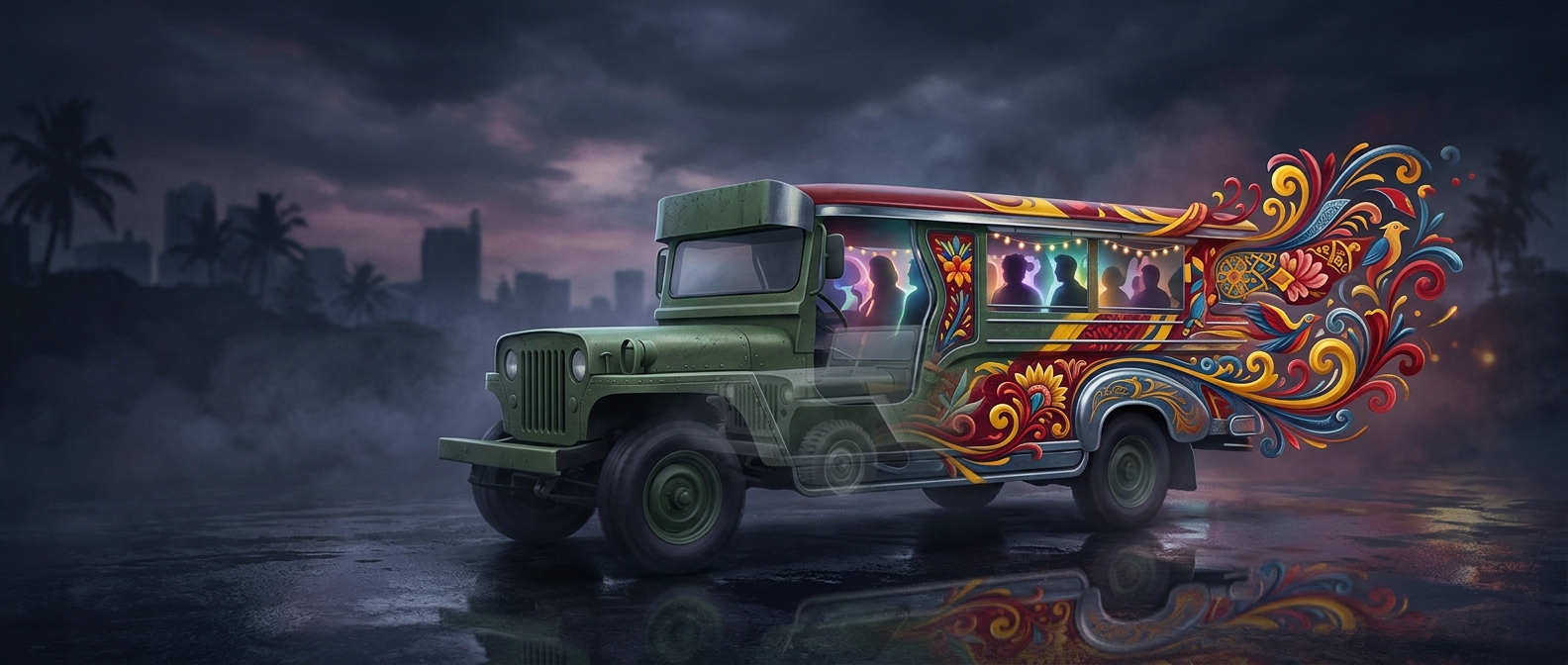
A surplus military jeep could carry only a small crew. In postwar Manila, operators turned that compact vehicle into something more useful for a crowded city: a longer passenger compartment, a roof for shade and rain, and bench seating that could carry several riders at once. As the original jeeps wore out, local workshops built larger versions that kept the recognizable shape but were designed for public transport.
The name jeepney is commonly linked to “jeep” and “jitney,” a word for a small passenger vehicle. The transformation was practical: a vehicle assembled from available parts could begin earning fares without the cost of a full-size bus.
A Flexible Bus for Manila’s Streets
Jeepneys filled a gap between private cars and larger transit. They could carry passengers along local roads and stop to pick up or drop off riders, making them useful for trips that did not begin or end near a major station. Their small size also let them navigate streets where a bus would be less convenient.
That flexibility shaped the ride. Passengers sat close together on long benches, and the driver’s fare-taking and loading had to work within a tight space. A jeepney was not simply a smaller bus; it was a vehicle whose capacity and operation had been adapted to everyday neighborhood travel.
Utility Became a Manila Signature
As the vehicles evolved, their painted bodies became highly visible among the city’s traffic. Decorations varied from one owner or workshop to another, making each jeepney easy to recognize even as the basic form remained familiar. The result was a distinctive blend of improvised engineering and public service: a wartime vehicle’s afterlife became part of Manila’s daily commute.