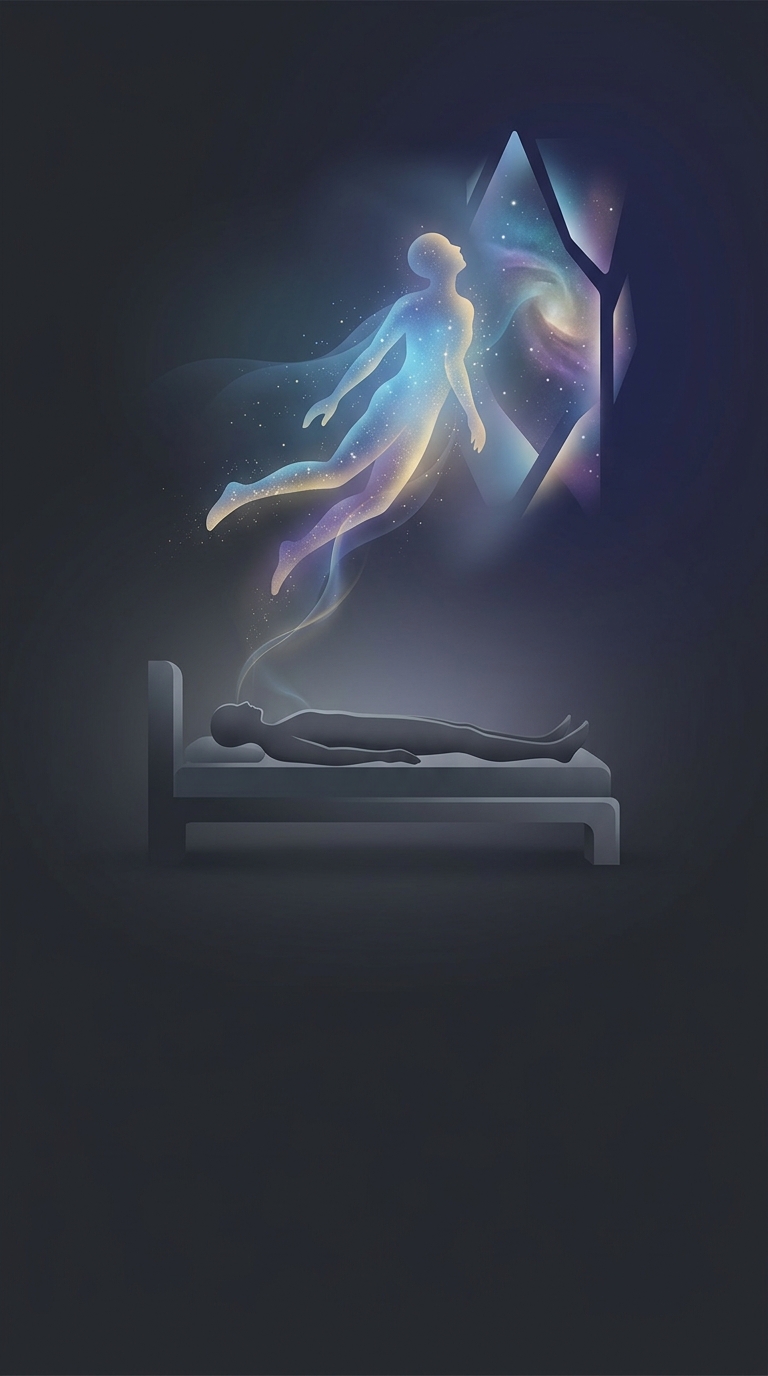
Why an Out-of-Body Experience Can Feel Like Travel
People who describe astral projection often report more than a vivid dream: they feel located outside their body, sometimes looking back at it or moving through a room. The experience can seem unusually convincing because the brain normally builds a sense of “where I am” by combining signals from vision, touch, balance, and the body’s position. When those signals no longer line up, that sense of location can become unstable.
When Sleep Blurs the Boundary
During sleep paralysis, awareness returns while the body’s temporary muscle inhibition from dreaming has not yet lifted. A person may be unable to move, even though they are conscious of the room. Dream imagery can continue into that half-awake state, while disrupted balance and body-position signals may contribute to the feeling of floating, rising, or being somewhere other than the bed.
In a lucid dream, the dreamer recognizes that they are dreaming and may be able to steer what happens. If that sense of control overlaps with paralysis or a half-awake state, an imagined journey can feel intentional rather than random. These are possible neurological explanations for some reported experiences, not proof that every account has the same cause.
One Experience, Different Interpretations
Astral projection gives this sensation a spiritual interpretation: that a nonphysical self has traveled beyond the body. A neurological account instead explains how the brain might create the sensation of separation and movement. The experience can be powerful under either interpretation; what changes is the explanation attached to it. That gap—between a vivid feeling and what it proves about the world—is why the experience remains meaningful to believers and intriguing to researchers alike.