What a Cheese Dream Could Mean in Artemidorus’s Handbook
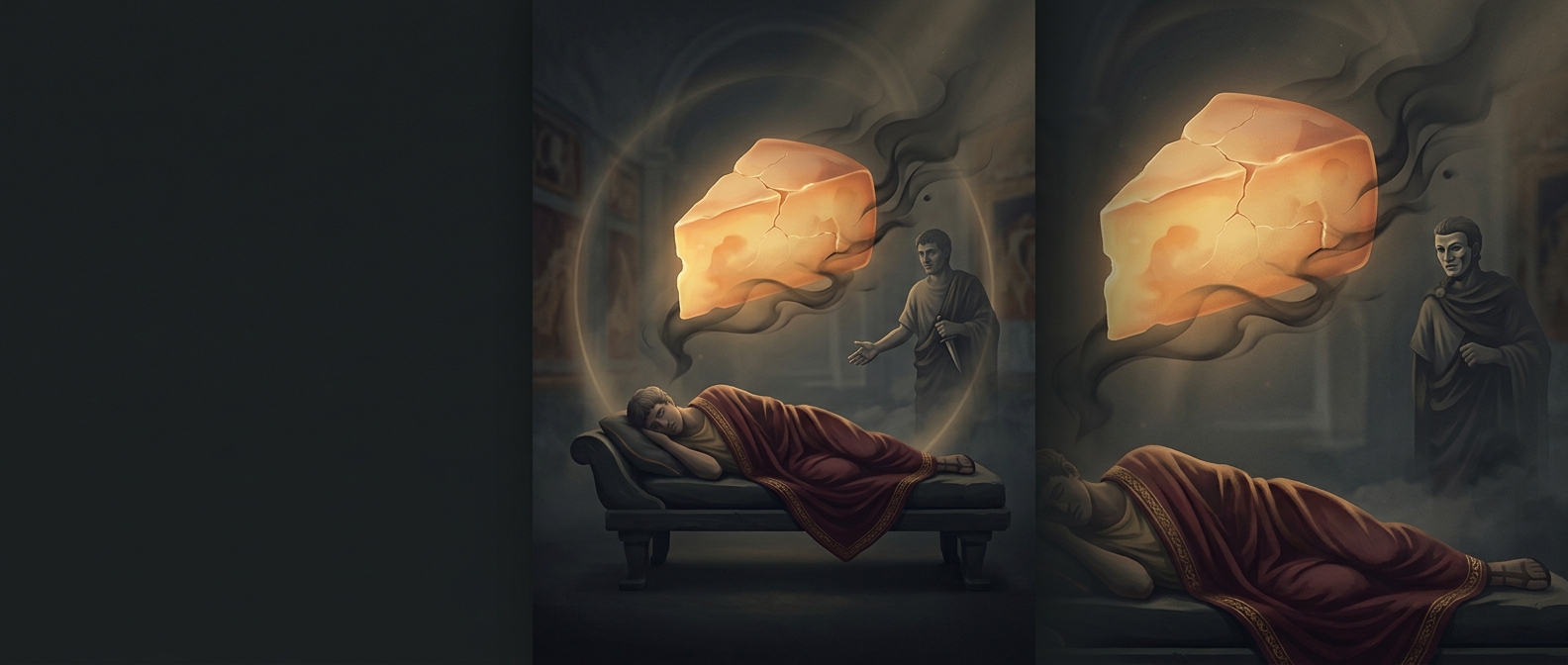
In the second century, the Greek writer Artemidorus collected dream interpretations in the Oneirocritica, a guide that treated dreams as signs to be read rather than as random images. Its entry linking cheese with betrayal turns an ordinary food into a warning about trust: the dream’s meaning lay not in cheese itself, but in what it was taken to predict about the dreamer’s life.
That was the handbook’s practical appeal. A reader could bring an unsettling or puzzling dream to an interpreter and ask what it signaled. Artemidorus’s collection offers a record of the associations available in his world, not proof that every Roman—or every ancient dream reader—used the same code.
A Dream Dictionary, Not a Universal Code
The cheese prediction is striking partly because it sits beside meanings that can seem just as unexpected. The same manual reportedly associated dreaming of a badger with wealth. Such pairings show how far ancient dream interpretation could be from a modern idea that a symbol has one obvious, universal meaning.
For Artemidorus, a dream image could point toward a future event, including an act of disloyalty. The surviving entry does not tell us why cheese was connected to betrayal, so it would be a mistake to invent a neat explanation—such as claiming that the food’s texture or spoilage carried a fixed symbolic message. What the rule does reveal is the handbook’s basic promise: even a mundane image might be treated as a clue about consequential events in a person’s social life.