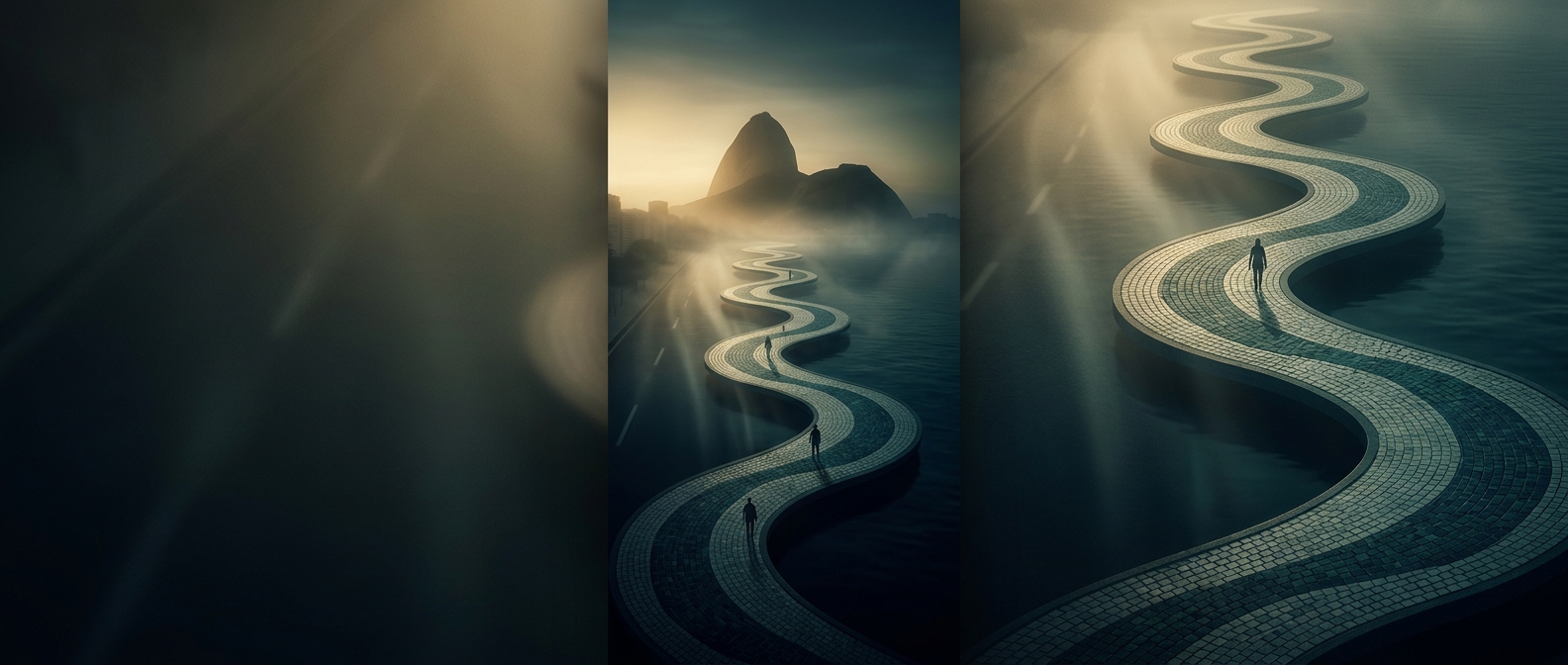
A Shoreline Drawn in Stone
Copacabana’s famous promenade turns a beachside walk into a visual extension of the ocean. Its black-and-white waves are made from small stones set into the pavement by hand, a technique known as Portuguese pavement. The pattern’s rolling bands were designed to suggest surf breaking along the shore, so the beach’s movement seems to continue beneath pedestrians’ feet.
Why the Pattern Works
The design depends on contrast and repetition. Dark and light stones form broad curves that stay legible across a long stretch of walkway, while their repeating rhythm gives the surface a sense of motion. Seen from above, the pattern reads almost like a drawn wave; at street level, it becomes a shifting sequence of curves as people walk through it.
That makes the promenade more than a route between the city and the sand. Its paving gives Copacabana a recognizable visual identity, and the motif has proved easy to adapt elsewhere: other boardwalks have borrowed the wave pattern to evoke a connection to the sea. The ocean is not only beside the walk here—the design makes it part of the ground.