Why a falling person can outrun sound
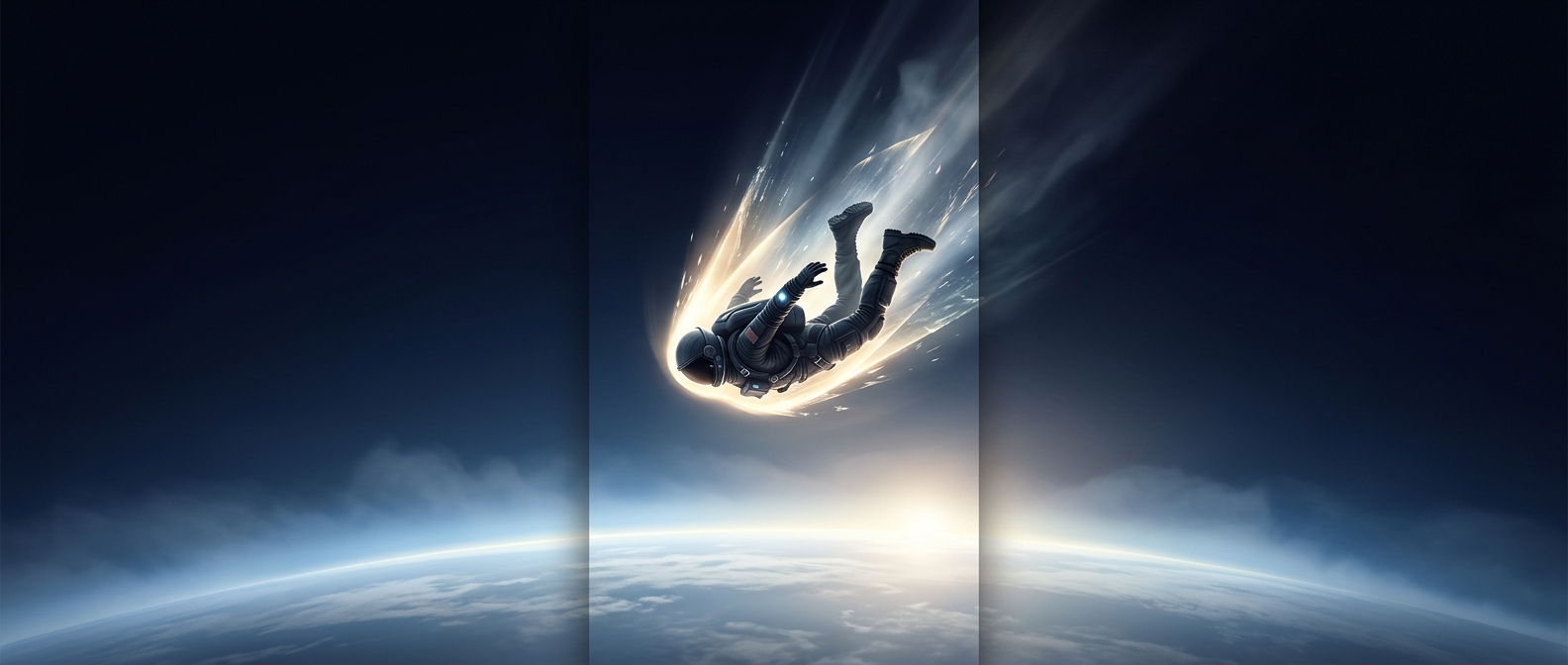
A skydiver does not need an engine to reach supersonic speed. At very high altitude, the air is sparse, so a falling body collides with fewer air molecules and experiences less drag. Gravity can then accelerate the person to speeds that would be impossible near the ground, where thicker air pushes back much harder.
The sound barrier is not one fixed speed everywhere: the speed of sound changes with the air’s temperature. But in the thin upper atmosphere, a sufficiently fast fall can still overtake the pressure waves traveling ahead of the body. Those waves bunch together into shock waves—the same basic kind produced by a supersonic aircraft.
The atmosphere supplies the brakes
Drag grows as a falling body moves faster, and it also grows as the air gets denser. A skydiver may therefore keep accelerating at high altitude, then slow down while descending into thicker air. The balance point where drag equals the pull of gravity is called terminal velocity; it is higher in thin air and lower near the ground.
This changing resistance is why supersonic freefall is a brief, altitude-dependent feat, not a speed a person can maintain all the way down. The diver also needs specialized equipment and life support to cope with the hostile conditions at extreme altitude. The striking part is that the atmosphere itself both permits the plunge and, lower down, acts as its brake.