A forest courtship, timed in flashes
In the Appalachian woods, the light show is also a mating display. Male synchronous fireflies—most famously Photinus carolinus in the Great Smoky Mountains—rise above the leaf litter and send out repeated bursts of light. Females, usually perched low in the vegetation, answer with flashes of their own. The pattern helps each insect recognize a potential mate amid the darkness.
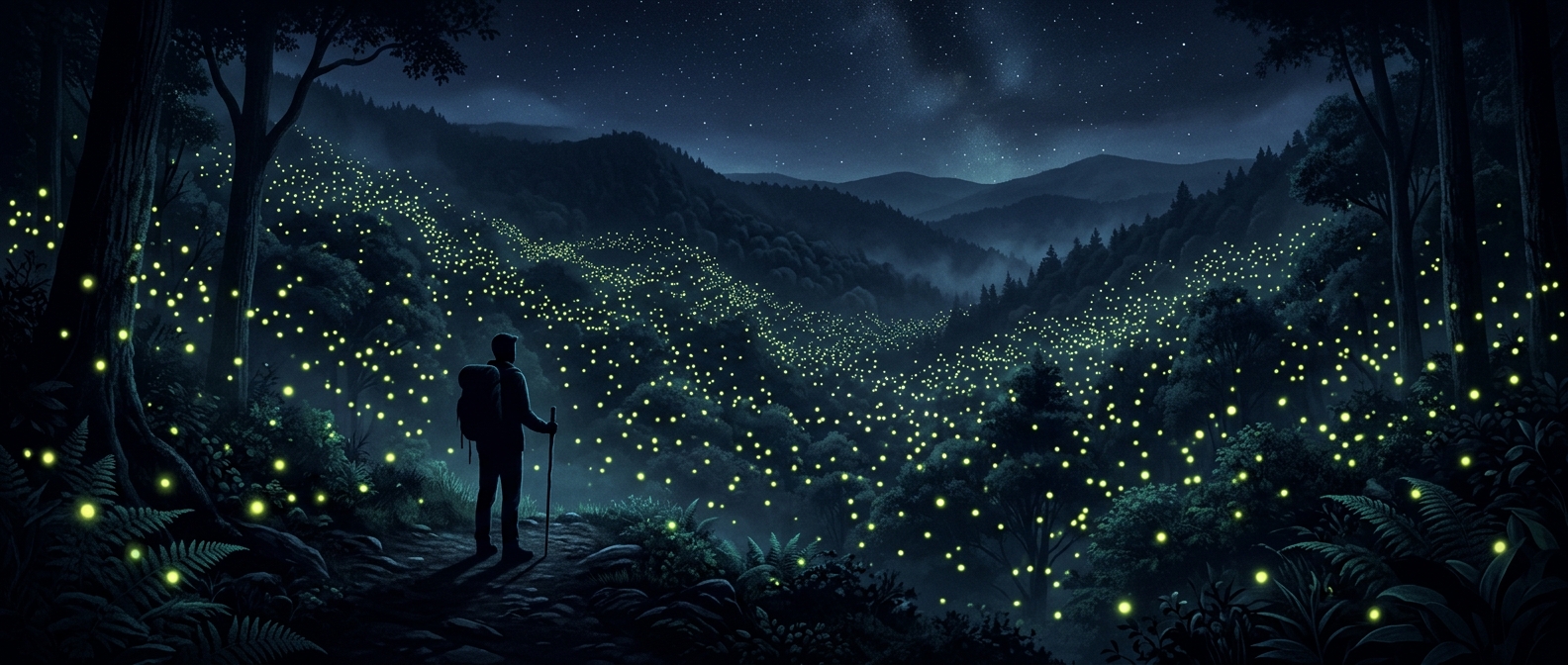
The males do not take turns according to a single leader. Their flashing can fall into step as each responds to the light it sees from nearby fireflies. In a dense group, those local adjustments can produce waves of nearly simultaneous flashes, followed by brief dark pauses. The result is less like a steady glow than a rhythm spreading through the trees.
Why the setting matters
The display depends on more than the insects. A dark, sheltered forest makes the flashes easier to see, while damp woodland conditions provide the habitat these fireflies need. In Great Smoky Mountains National Park, the Elkmont area is a well-known place to witness the event; its narrow seasonal window reflects the fireflies’ breeding cycle and changing spring conditions, rather than a show that can be scheduled on demand.
For visitors, that means patience is part of the experience. As the sky darkens, individual flashes may gradually gather into synchronized bursts across the forest floor and understory. The spectacle is a glimpse of courtship at work—and of how many tiny, nearby responses can make an entire landscape seem to pulse.