When the scenery stopped being a barrier
A racing game needs more than convincing images of roads, hills, and trucks. It also needs invisible rules that tell the software where solid objects begin and end. Collision detection is the process of checking whether a moving object has hit one of those boundaries—and what should happen next.
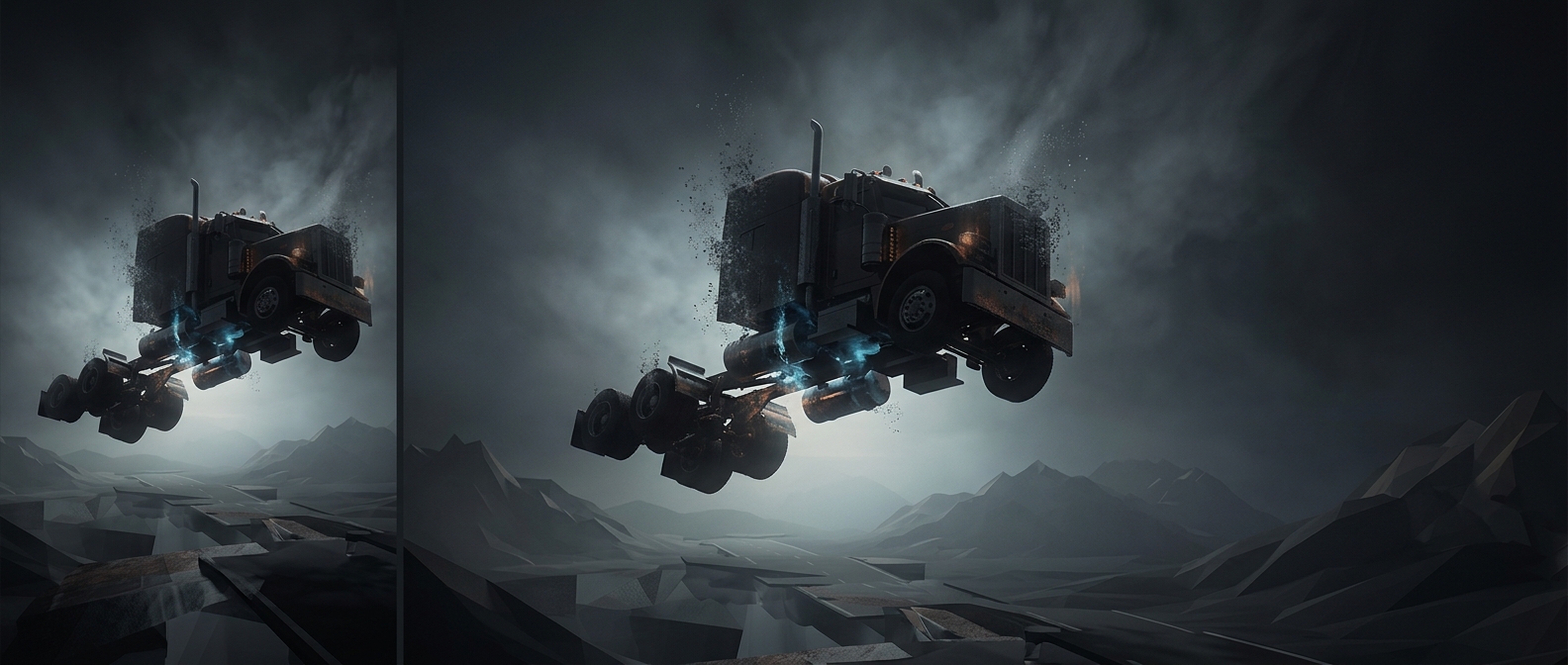
In Big Rigs: Over the Road Racing, that layer of interaction was missing or failed so broadly that the landscape could look like an obstacle without behaving like one. A truck could continue through a mountain because the game was not reliably stopping it at the mountain’s surface. The result exposed the gap between a world that appears solid on screen and one the game actually enforces.
Why reverse could run away
Collision checks and speed limits solve different problems. The first keeps a vehicle from passing through terrain; the second keeps its motion within intended bounds. If reverse acceleration has no effective cap, each update can make the truck move faster than before. At extreme values, calculations and other game systems may no longer behave as intended, and the game can become unstable or crash.
These failures are revealing because they are not simply awkward driving. They point to missing or ineffective safeguards in separate parts of the game: one meant to constrain where the truck could go, another meant to constrain how fast it could move. In ordinary play, a mountain should stop the truck and a speed limit should keep motion manageable. Here, the scenery could be crossed and reverse could become an uncontrolled route toward a crash.