How a flea turns muscle into a launch
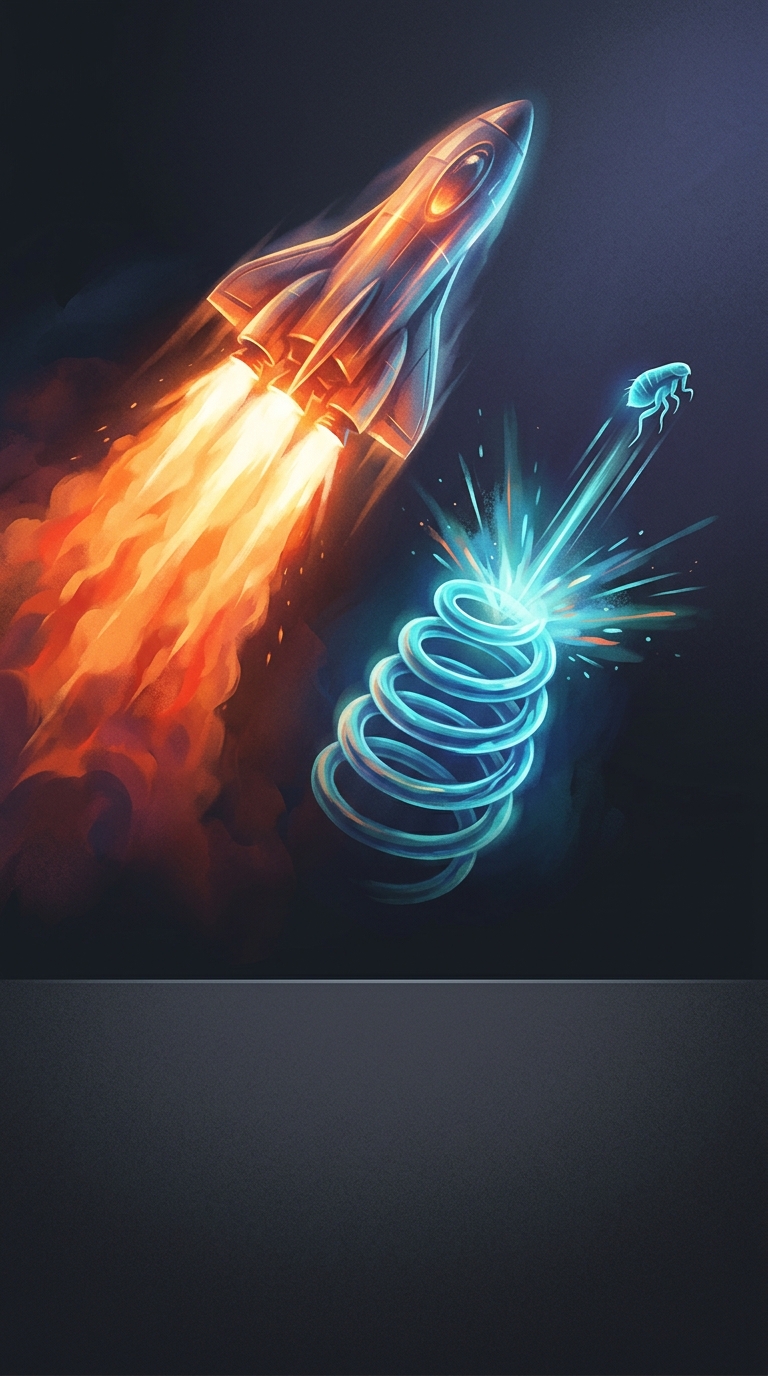
A flea’s leg muscles cannot deliver all their force in one brief burst. Instead, they load an elastic structure in the body, bending it gradually while the insect remains still. The structure acts like a spring: it stores energy as it deforms, then releases that energy much faster than the muscles could contract on their own.
A catch holds the loaded mechanism in place until the flea is ready. When it lets go, the spring drives the legs against the ground, sending the flea upward. This arrangement is a form of power amplification: the muscles supply the energy, but the spring releases it at a higher rate.
Why the acceleration is so extreme
Acceleration measures how quickly velocity changes, not how high an object eventually travels. A flea’s body is pushed from rest to takeoff speed in a tiny fraction of a second, so the change happens over a very short time and produces an enormous acceleration—on the order of a hundred times Earth’s gravitational acceleration.
That comparison describes the flea’s brief launch, not a sustained force like gravity acting on it throughout a journey. Once airborne, the flea is no longer being pushed by the ground. Its small size also matters: the jump is a rapid burst that moves a tiny body, rather than the kind of prolonged acceleration needed to propel a large vehicle.
The spring-and-catch system solves a practical problem: it lets a flea build up energy without jumping prematurely, then spend it almost all at once. The remarkable part is not that its muscles are extraordinarily fast, but that they can charge a spring and release the stored energy in a blink.