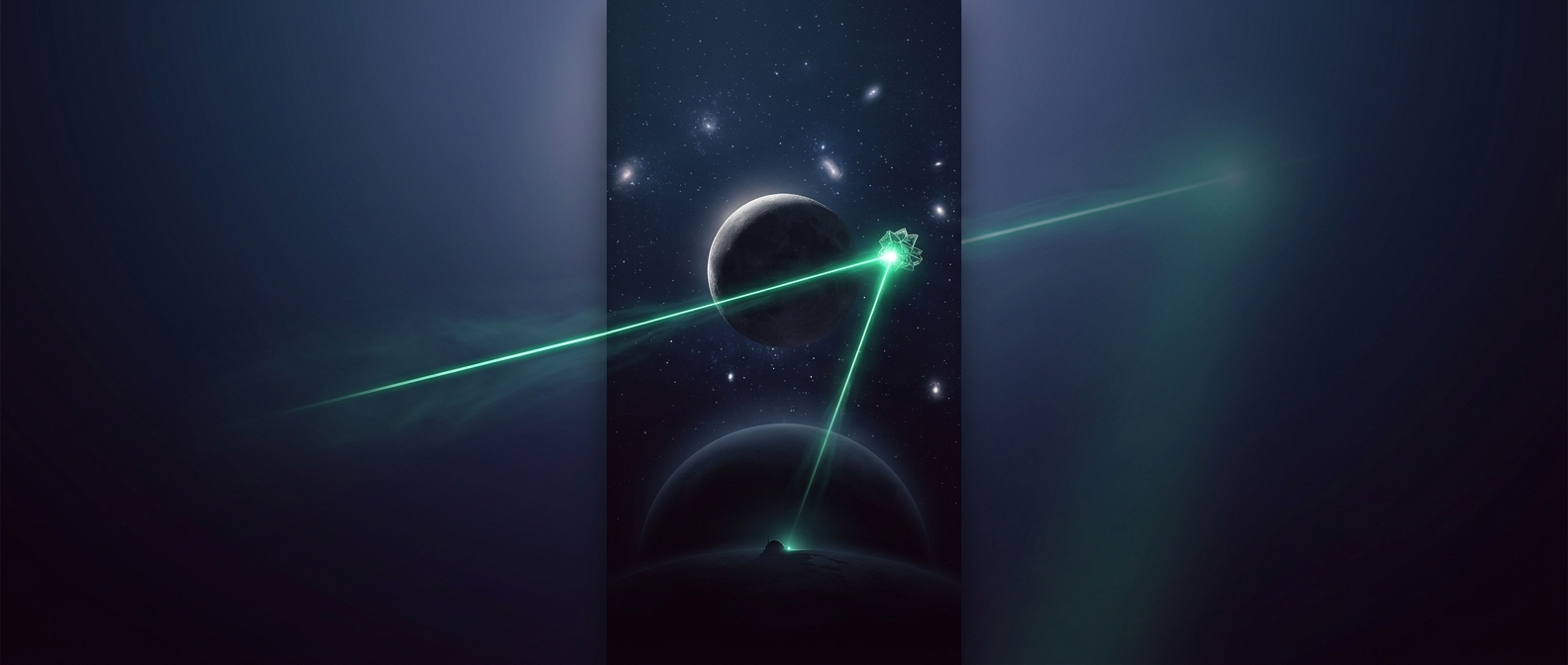
Why the panels send light back
A conventional mirror reflects light away at an angle determined by how it is tilted. The lunar panels instead use corner-cube retroreflectors: groups of three small, perpendicular reflective surfaces. A beam entering a corner cube reflects off all three faces and leaves traveling almost exactly back the way it came. That makes the return much less dependent on the panel’s orientation than it would be with a flat mirror.
Turning a flash into a distance
An observatory sends a brief laser pulse toward a panel and records when the reflected light arrives. Because the pulse makes a round trip, scientists divide its travel time by two and use the speed of light to calculate the distance to the Moon. Repeating the measurement reveals how that distance changes as the Moon moves in its orbit.
The measurement is demanding: the beam spreads over the long journey, and only a tiny fraction of its light returns to Earth. Sensitive detectors must pick out the faint returning signal and distinguish it from background light. The panel does not amplify the beam; its geometry simply directs a small portion back toward the sender.
A lasting measurement point
The reflectors gave researchers fixed targets on the lunar surface, allowing distance measurements to be repeated long after the missions that placed them there. Their enduring value is practical: instead of estimating the Moon’s position from a photograph, scientists can time a light pulse’s journey to a known spot and watch the Earth–Moon distance change.