How Bain’s telegraph copied a picture
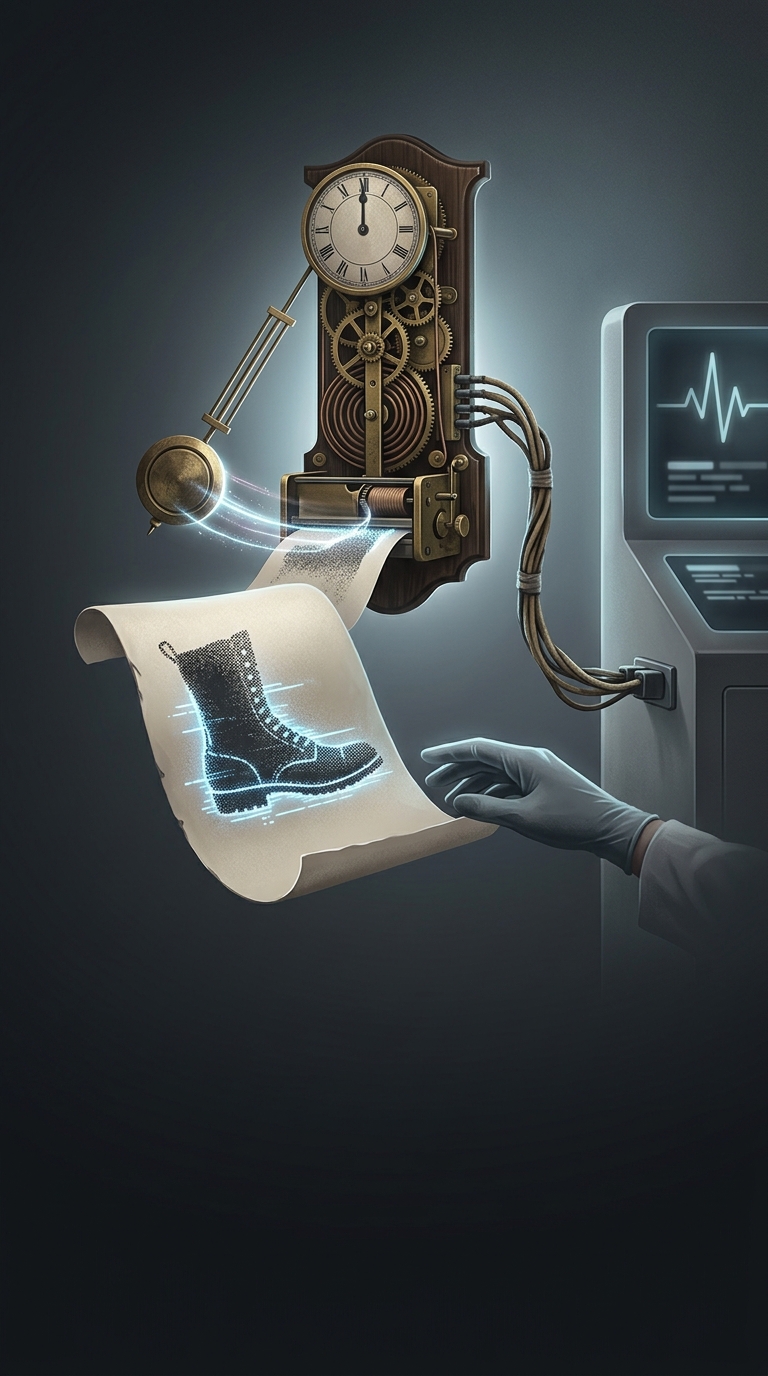
Alexander Bain’s 1843 machine turned an image into a timed sequence of electrical signals. At the sending end, a metal plate carried the picture in electrically conducting ink. A moving stylus crossed the plate line by line; when it touched the ink, it completed a circuit and sent current down the telegraph wire.
At the receiving end, another stylus moved across paper treated with chemicals that darkened when electricity passed through them. Current switched on and off as the sending stylus met ink or bare plate, so the receiver laid down corresponding marks. Repeating that process across the surface gradually rebuilt the image.
The crucial problem was keeping time
The two styluses had to travel in step. If the receiver moved too quickly, too slowly, or started at the wrong moment, each mark landed in the wrong place and the copy stretched or skewed. Bain’s design used pendulums to coordinate the motion at both ends, making synchronization—not just sending a signal—the key to transmitting a recognizable picture.
That was a demanding requirement for a telegraph system: a message could tolerate some variation in timing, but an image depended on thousands of marks arriving in the right order and position. Bain’s apparatus showed how an electrical line could carry more than coded text, even though practical image transmission would require later improvements in scanning and synchronization. Its most striking idea was already there: turn a flat picture into a pattern of changing current, then use that pattern to draw the picture again far away.