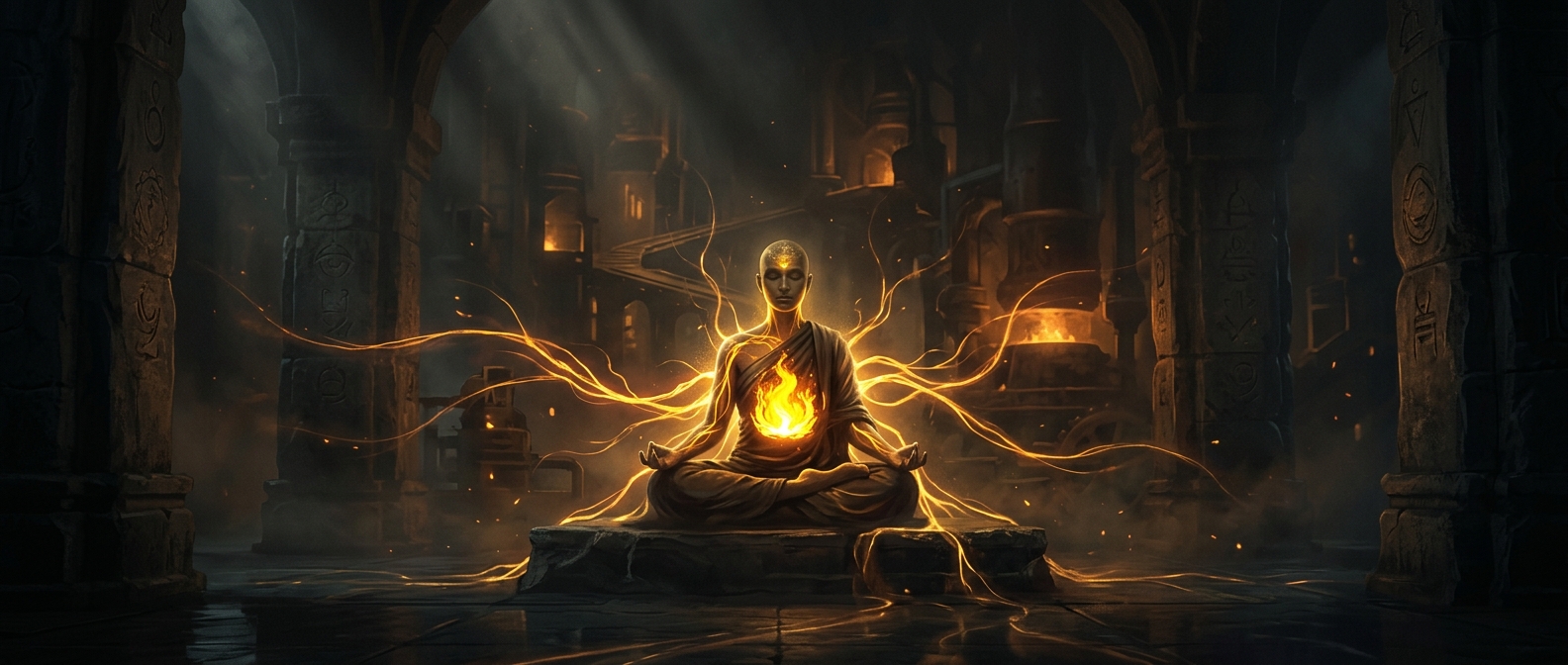
Manipura and the symbolism of inner fire
In yoga and Hindu and Buddhist subtle-body traditions, Manipura is commonly described as a chakra—a center in a symbolic map of the body—around the navel or solar-plexus area. Its name is often translated as “city of jewels.” Traditions differ in their details, but Manipura is frequently associated with fire, digestion, confidence, and the ability to act on intention.
Calling it an energetic “power plant” is metaphorical, not a claim about a physical organ generating a measurable force. The image gives personal drive a shape: like fire, it can provide warmth and make work possible, but it can also consume more fuel than a person can sustain.
When drive becomes excess
The same symbolic energy that supports resolve can, in this framework, become controlling or restless when out of balance. A person might push past the need for rest, treat every task as a test of worth, or try to direct other people as tightly as they direct themselves. The result is the “overwork and friction” associated with unchecked fire—not because a chakra has been medically shown to cause those problems, but because the metaphor links ambition with its costs.
That double meaning is useful: the goal is not simply to make the fire stronger. It is to cultivate enough steadiness to use determination without letting it govern every choice.
A guide for reflection
Some yoga and meditation practices draw on chakra imagery to focus attention on qualities such as agency and self-discipline. Used this way, Manipura can prompt practical questions: Is this effort purposeful, or am I unable to stop? Am I acting with confidence, or trying to control the outcome? The “fire” becomes a way to examine how will is being spent—especially when productivity begins to crowd out rest or cooperation.