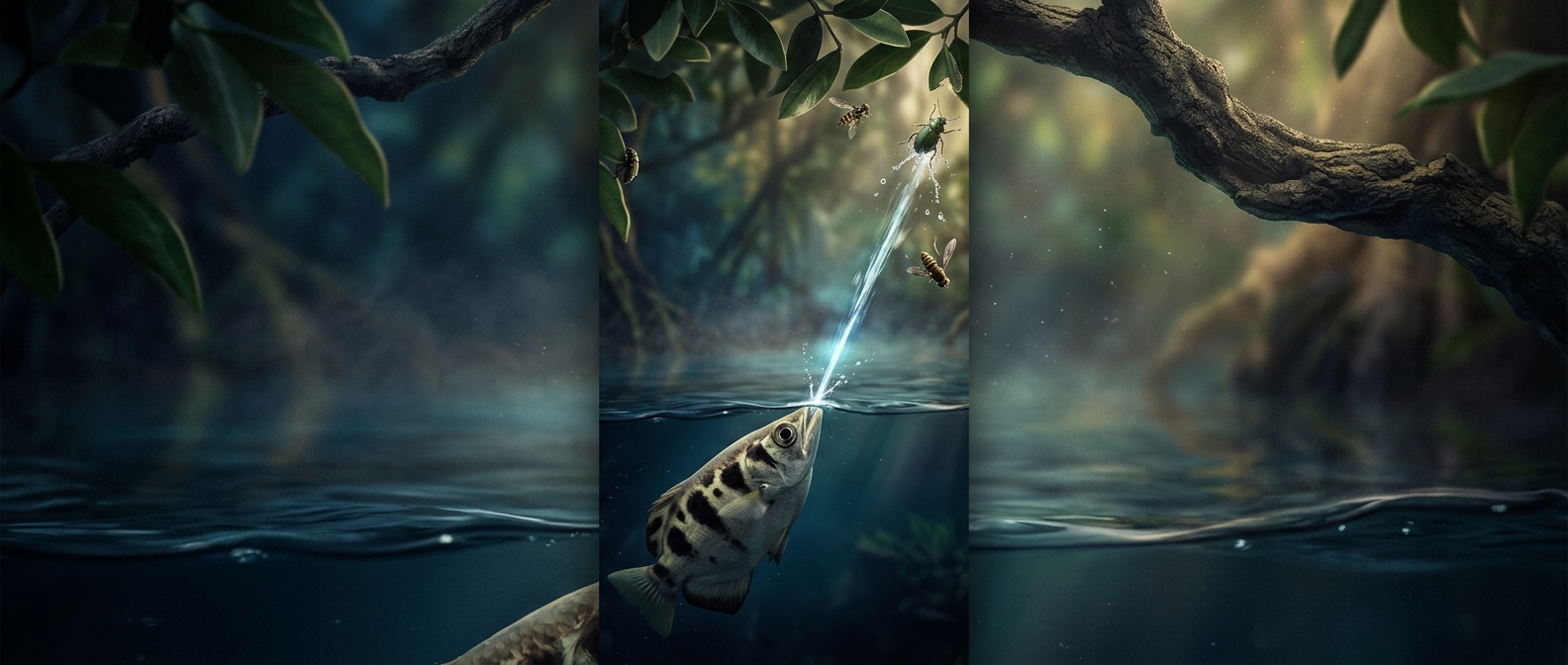
Why the Insect Appears in the Wrong Place
From below the surface, an archerfish does not see an insect exactly where it is. Light changes direction when it passes from air into water, a bending effect called refraction. The insect’s image therefore appears displaced from its actual position, and the amount of shift depends on the angle at which the fish views it.
That creates a practical problem: aiming at the apparent image can send the water jet past the target. The fish must use the visual position it sees to estimate where the insect really is.
Turning a Visual Estimate into a Shot
An archerfish forms a narrow stream by pressing its tongue against a groove in the roof of its mouth while forcing water out. It adjusts the direction of the shot to reach prey above the surface. In effect, its eyes provide a distorted map, and its aim has to compensate for the distortion before the water leaves its mouth.
The correction is not one fixed adjustment. A target viewed at a steep angle is displaced differently from one viewed more sideways, so the fish’s aim must suit the particular line of sight. A successful shot also has to knock the prey loose, sending it down to the water where the fish can eat it.
The Surface Is Part of the Target
For the archerfish, hunting is not simply a matter of pointing at an insect. It means interpreting a scene across a boundary that shifts the apparent location of everything above it. The fish has to aim for the insect’s real position, not the spot its eyes seem to place it.