How cosmic voids form
After the Big Bang, matter was spread almost—but not perfectly—evenly. Gravity slowly amplified those tiny differences: regions with slightly more matter pulled in more, while surrounding regions became comparatively depleted. Over billions of years, matter gathered into galaxies and long filaments, leaving broad spaces between them with far fewer galaxies.
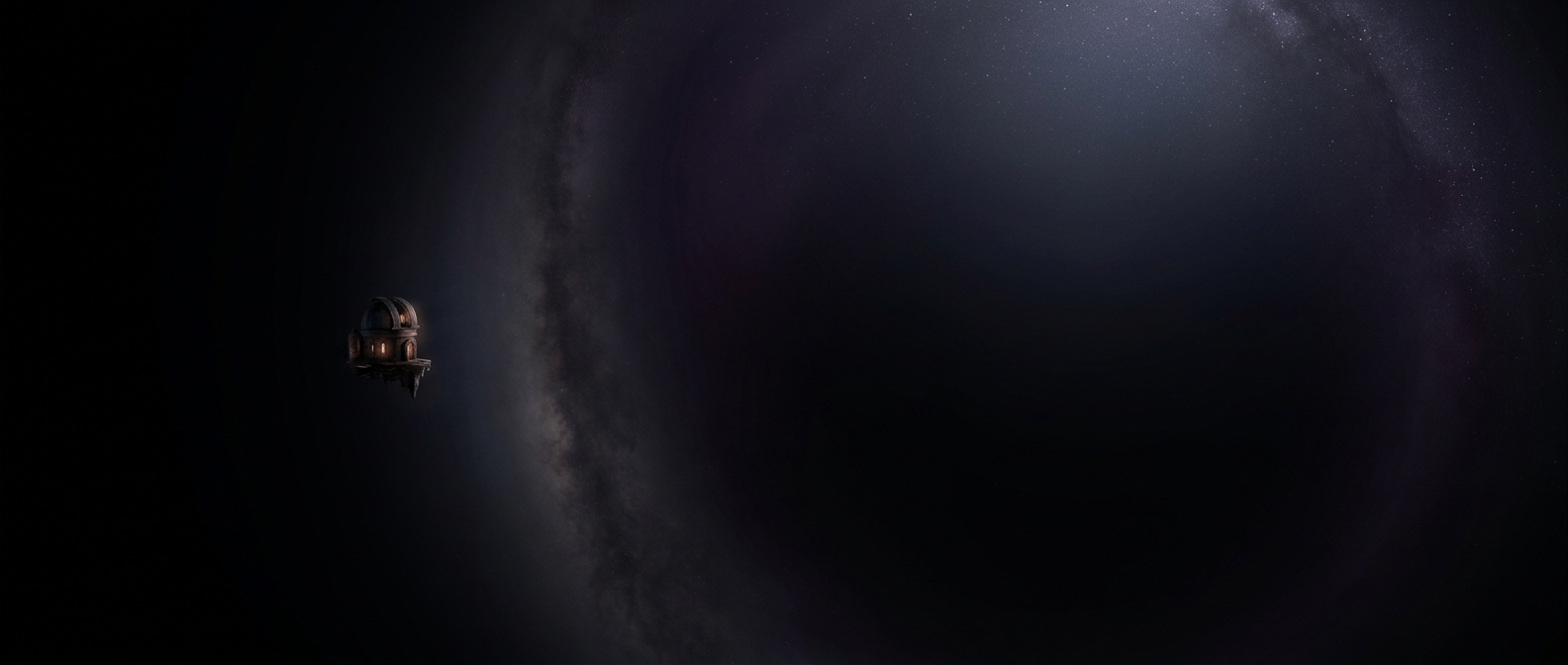
These spaces are called cosmic voids. They are not cavities with sharp walls; their edges are gradual, defined by the contrast between sparse regions and the denser structures around them.
What “empty” really means
A void still contains matter. Thin gas and dark matter remain spread through it, but there is much less material available to gather into galaxies. Dark matter is matter that does not give off or reflect light; astronomers infer its presence from gravity, including the way it helps shape the larger distribution of galaxies.
Because galaxies are easier to see than diffuse gas or dark matter, maps of the universe can make voids look more vacant than they are. “Empty” is a comparison with the bright, crowded filaments—not a claim that nothing exists there.
Why the gaps matter
The contrast between dense strands and sparse regions reveals the large-scale pattern of cosmic structure. A void is part of that pattern, much like the open spaces between branches help define a tree’s shape. Its apparent emptiness is evidence of how gravity redistributed matter across the universe, not a hole in reality.