How Astronomers Trace a Hidden Cosmic Pull
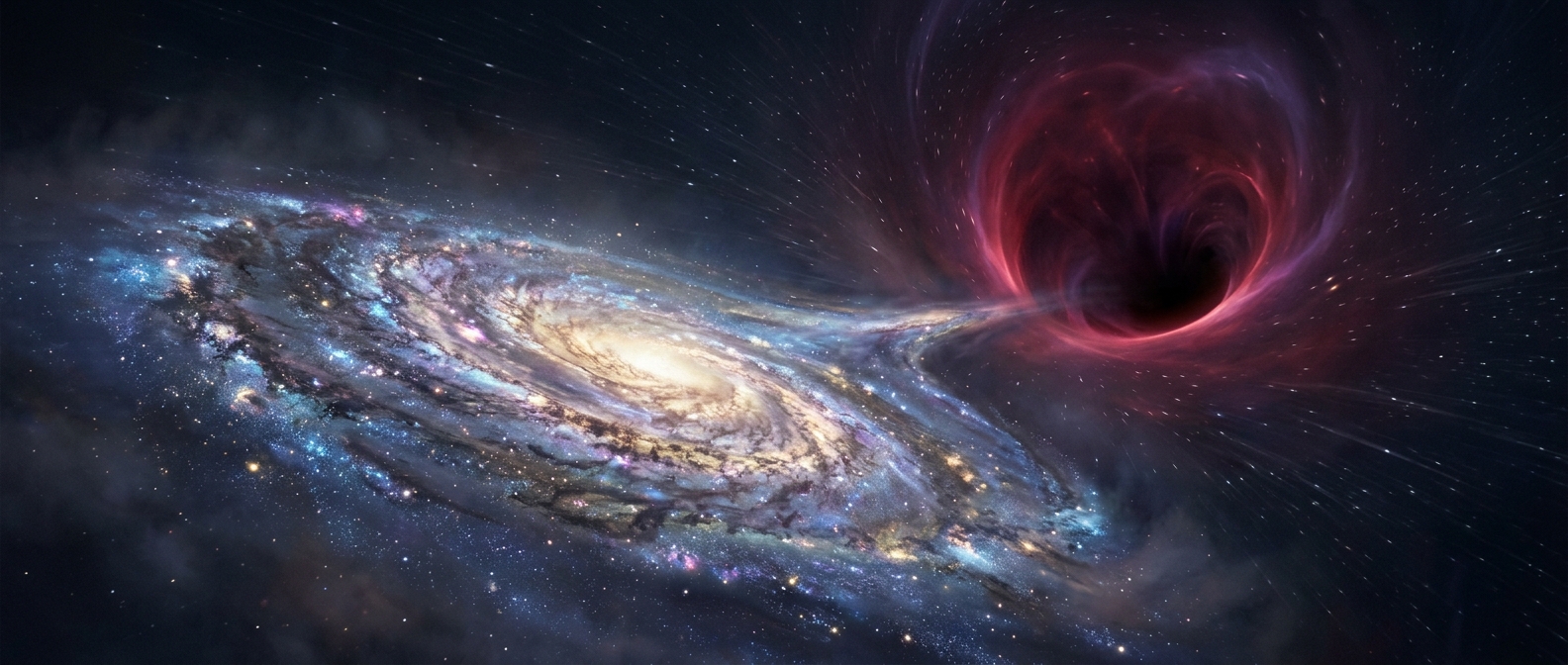
A massive concentration of matter can reveal itself through motion. Gravity changes how galaxies travel, so astronomers compare their measured movements with the expansion of the universe. When many galaxies share an extra drift in a similar direction, that coordinated motion points to a region exerting a strong gravitational influence.
The evidence is not a visible object tugging like a hook. It is a pattern across many galaxies: their velocities differ from the smooth outward flow expected as space expands. Astronomers use those differences to map where mass is concentrated, including matter that emits little or no detectable light.
Why the Source Is Hard to See
The Milky Way’s central band creates a blind spot in ordinary views of the sky. Its disk contains thick clouds of dust, which absorb or scatter visible light, along with dense fields of stars that crowd the background. A distant galaxy behind that strip may be difficult to spot or study even when its gravity affects its surroundings.
That is why the motion can be clearer than the picture. Galaxy surveys can measure the movement of objects outside the obscured zone and show that their paths converge toward a broad region. Observations in other wavelengths, which pass through dust more effectively, can help reveal what visible-light images miss, but the gravitational map is built from the motions themselves.
A Map Made From Motion
The hidden pull need not come from one compact object. A large-scale gravitational influence can arise from a wide distribution of galaxies and other matter. Astronomers therefore treat the “source” as a mass-rich region to investigate, not necessarily a single body waiting to be photographed.
The striking consequence is that the universe can be charted even where the view is blocked: galaxies act like tracers, and their shared drift marks where gravity has gathered matter.