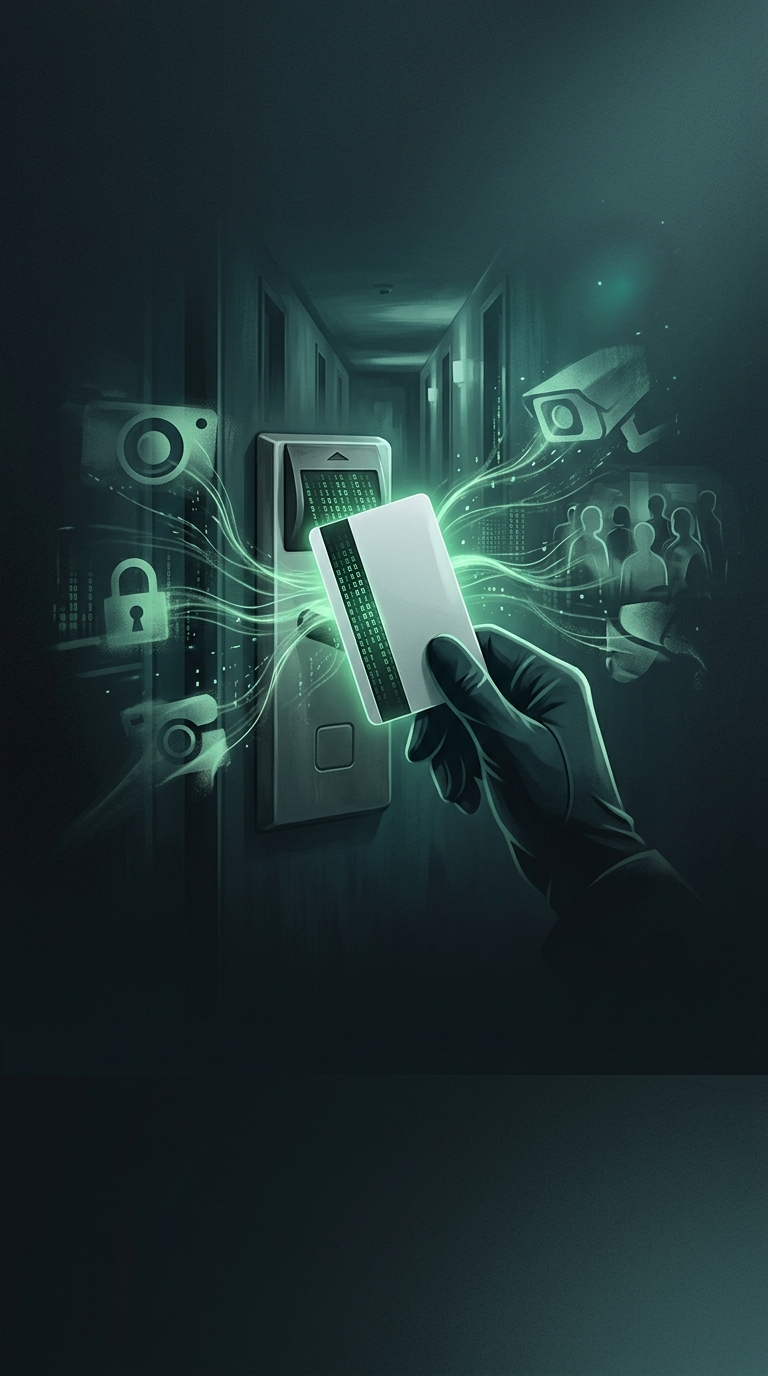
The stripe can carry a copyable room credential
A magnetic-stripe room key works by storing data in tiny magnetized patterns along its dark band. When you swipe it, the lock reads those patterns and checks whether the credential is authorized for that door. Unlike a chip, the stripe does not perform a fresh cryptographic exchange with the lock; it simply presents the data recorded on it.
That creates the unsettling weakness: if a system accepts a stripe’s data as proof of access, someone who can read and reproduce that data may be able to make a working copy. A reader can capture the stripe, and a writer can encode the captured information onto another card. The copy need not look like a hotel key—the lock cares about what the stripe says.
What the risk depends on
A copied card is not automatically a universal pass. Hotels use different lock systems, and the data may be encoded or otherwise protected. A credential can also be limited by the doors it opens and by its validity period. The vulnerability matters most when an older system relies on easily copied stripe data and does not have an additional check that distinguishes the original card from a duplicate.
That is why a stripe key’s convenience comes with a security tradeoff: it is quick to issue and simple to use, but the information it presents can be easier to reproduce than a modern credential designed to prove its authenticity. For a guest, the practical implication is not that every room key can be copied by anyone nearby—it is that a lost stripe card should be treated as a lost key, and reported promptly so the hotel can disable it.