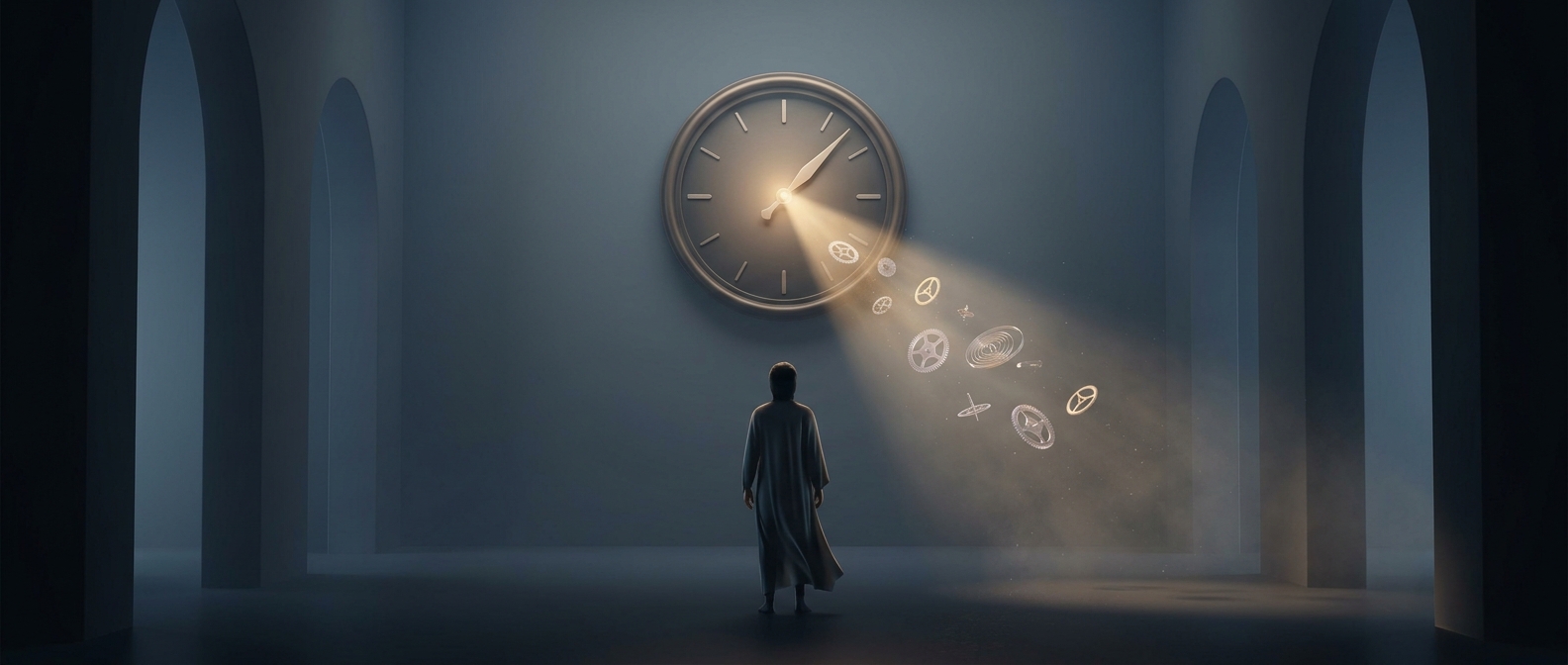
The eye’s jump leaves a gap in the picture
Your eyes do not glide smoothly from one point to another. They make rapid jumps called saccades. During each jump, the image sweeps across the retina, but the brain reduces the influence of that blur on what you consciously see. Otherwise, every glance would look like a smear.
That filtering creates a small gap in visual experience. You usually do not notice it because the brain combines what it sees before and after the movement into a stable scene. But the gap matters when you are judging how long something has been visible.
The clock seems to gain time
Look away, then flick your eyes toward a clock’s second hand. The first position you see can seem to hold for longer than an ordinary second. This effect is known as chronostasis—the impression that time has paused or stretched after a quick eye movement.
The brain has to make sense of the moment when the old view disappears and the new one arrives. One useful way to keep experience continuous is to treat the newly seen scene as though it began around the time the eye movement started, rather than only when the eyes settled. In effect, the clock’s first visible position is given some of the interval that passed during the glance.
The hand has not actually slowed, and the eye has not captured extra time. The distortion is in how the brain organizes the moment after the movement. That is why the effect is easiest to notice on a clock: a moving hand gives you a clear, familiar signal for testing whether a moment seemed to last too long.