Why a Shadow on Mountain Mist Can Look Giant
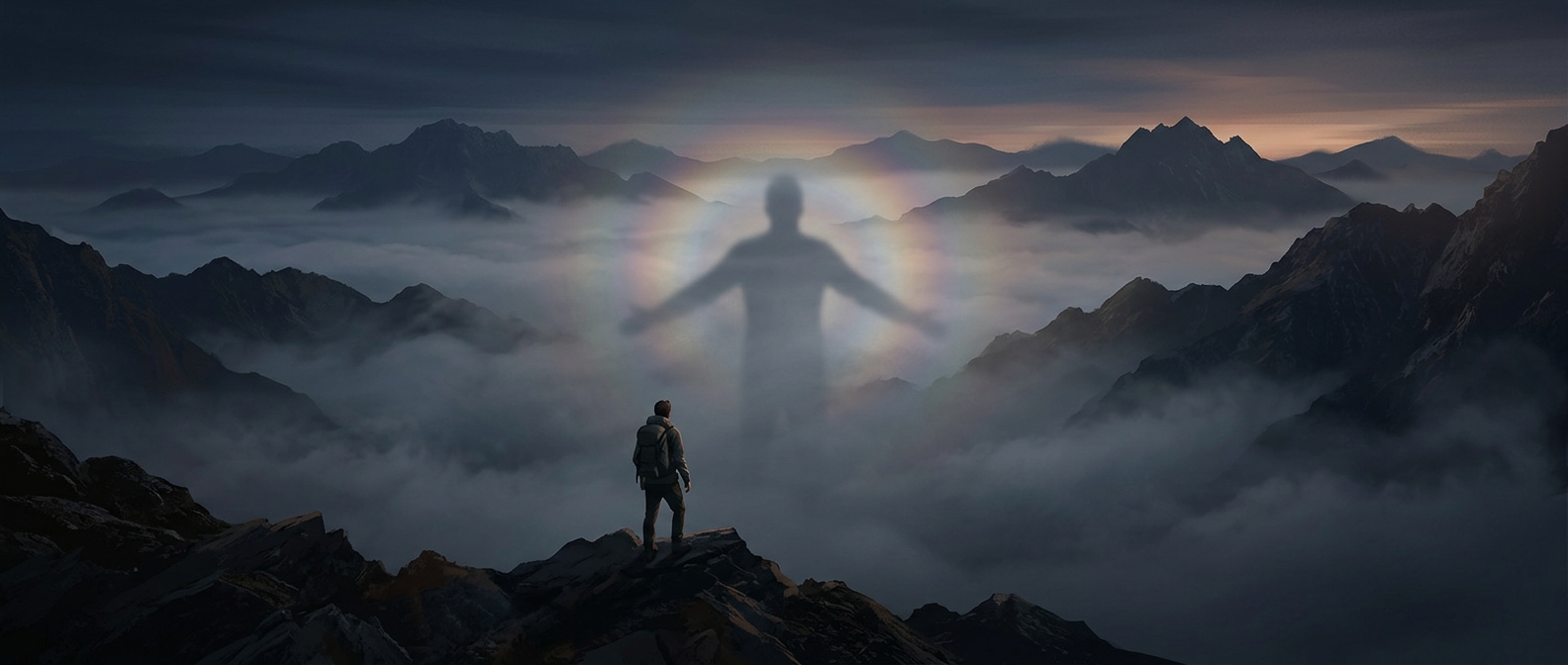
When sunlight comes from behind a hiker, the person blocks some of it and casts a shadow forward onto the cloud or fog below. The tiny water droplets in the mist scatter light back toward the observer, making the shadow visible. This mountain optical effect is known as a Brocken spectre, named for a peak in Germany where it has often been observed.
The Fog Becomes a Screen
The shadow is not usually falling on a distant, flat surface. It lands on a shifting volume of mist, and the part that makes it visible may be close to the observer even when the valley appears far below. Because fog offers few familiar clues to distance or scale, the shadow can seem far larger than the person who casts it.
Its apparent size also depends on geometry: a shadow spreads as it travels away from its source, and the observer sees it against whichever patches of mist scatter the light back. As the hiker moves, or the fog drifts, the shadow can slide, stretch, or seem to leap across the cloud. The figure is therefore not a fixed image in the valley but a changing projection on a moving screen.
Sometimes colored rings appear around the shadow. These are called a glory: sunlight is scattered and redirected by the tiny droplets in the cloud, producing rings centered opposite the Sun from the observer’s point of view. The striking scale of the figure comes from ordinary light and mist—but with almost no visual reference for size, a person can appear to tower over the mountain landscape.