How a Rubber Hand Enters the Body Map
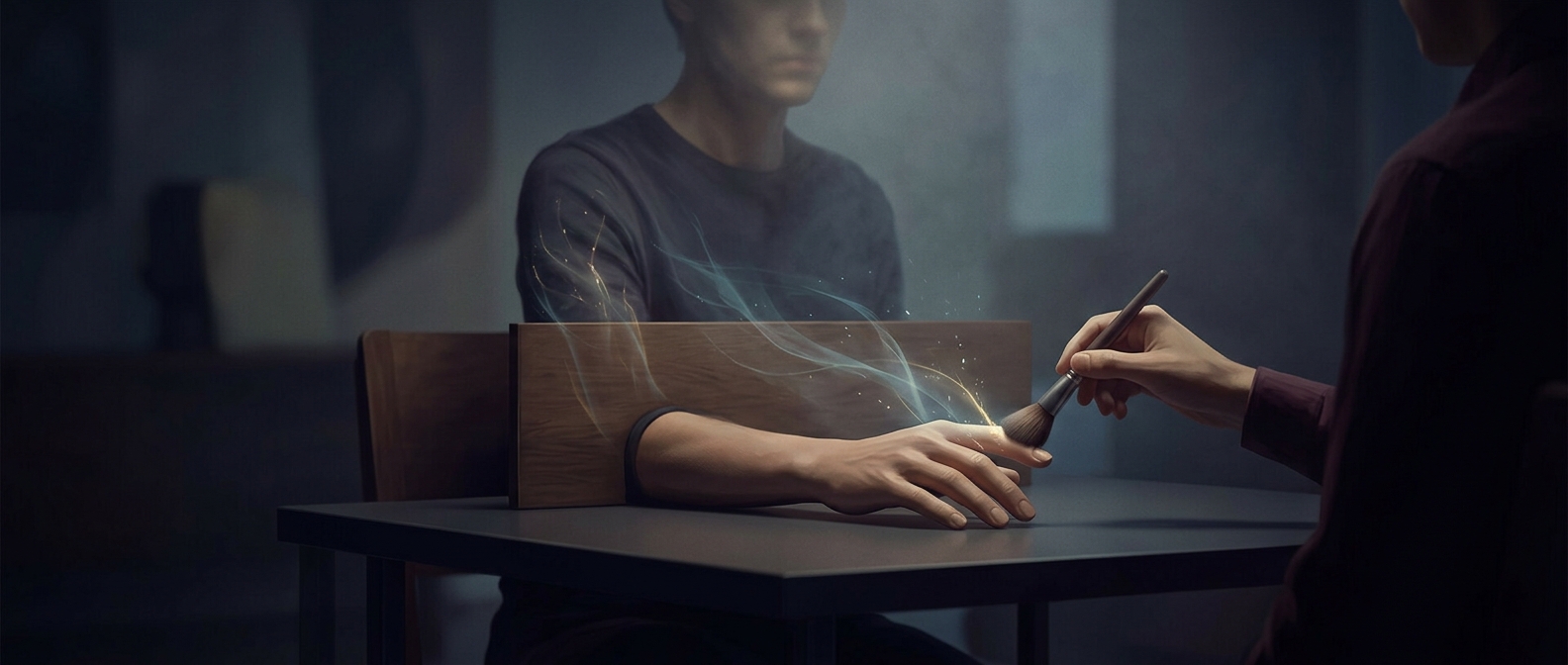
The rubber-hand illusion begins with a simple mismatch: your real hand is hidden, while a realistic fake hand sits where you can see it. An experimenter strokes the fake hand and your unseen hand at the same time, in corresponding places. After a short while, many people begin to feel as though the touch they see on the rubber hand is happening to them.
The brain does not rely on one sense alone to decide where the body is. It combines vision, touch, and information from joints and muscles about limb position. When those signals agree in timing and location, they can outweigh the quieter message that the real hand is somewhere else. The rubber hand is then treated, temporarily, as part of the body’s map—the brain’s working representation of where the body is and what belongs to it.
Why Timing Matters
Matching strokes give the brain a plausible explanation for two events: seeing a touch and feeling a touch. If the strokes are noticeably out of sync, that explanation weakens, and the illusion is less convincing. The effect is not simply that a person mistakes rubber for skin; it reflects how the brain resolves competing sensory evidence when one signal is hidden from view.
Researchers can also ask people to estimate where their unseen real hand is. During the illusion, their estimate may shift toward the rubber hand, suggesting that the experience involves more than a verbal belief. Perception of the hand’s location itself can change.
A Temporary Change in Ownership
The illusion shows why body ownership is not a fixed feeling produced by vision or touch alone. It is continually assembled from cues, and under the right conditions a carefully placed prop can enter that experience. That does not make the rubber hand literally part of the body, but it helps explain why a visible injury to a fake hand can prompt a real flinch: for a moment, the brain has treated the threatened object as its own.