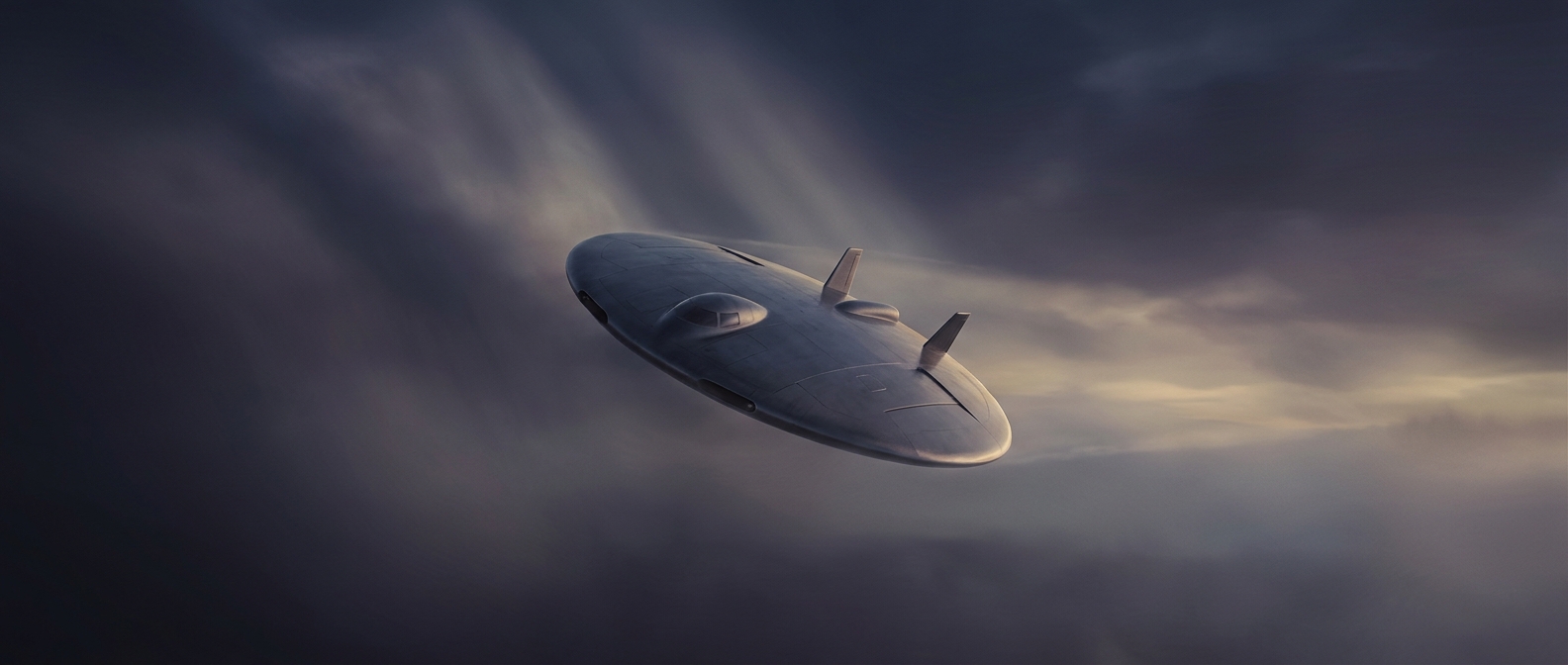
Why build an airplane like a disk?
The Vought V-173 was an experiment in making an airplane fly well when moving slowly. Its circular wing gave it a broad lifting surface in a compact shape. But wing area alone could not solve the main problem: at low speed, less air flows over a wing, so it produces less lift.
The unusual shape was part of a larger system. Two propellers sat at the front of the aircraft, near the wing’s outer edges. Their airflow—called propwash—swept across the wing even when the plane itself was barely moving forward. That helped the wing keep producing lift during slow flight.
Propellers did more than pull it forward
On an ordinary airplane, propellers mainly provide thrust while the aircraft’s forward motion carries air over the wings. The V-173’s propellers did both jobs: they pushed the aircraft ahead and accelerated air across much of its wing. In effect, the plane could create useful airflow before it had built up much speed of its own.
That arrangement also made the propellers and wing depend on one another. The wing needed the propwash to work effectively at low speed, while the propellers had to keep that air moving across the wing. The circular planform—the shape seen from above—made room for a large wing surface without the long, narrow span of a conventional airplane.
A flying test of an extreme idea
The V-173 was built to test this unconventional approach, not to look like a standard aircraft. Its flights showed that the disc-shaped design could work in the air; the shape was not merely a drawing-board curiosity. But making an experimental plane fly did not, by itself, settle whether the design was practical for wider use.
The memorable lesson is that its wing and propellers were designed as a team. The airplane’s broad disk supplied lifting area, and its propellers helped keep air moving over that area when ordinary forward speed was scarce.