The underground railway’s alternative to a smoky locomotive
Before electric trains became practical, a railway tunnel had a problem: a steam locomotive brought its fire, exhaust and smoke underground with it. One proposed workaround was to keep the engine in a stationary building and let it haul trains by cable.
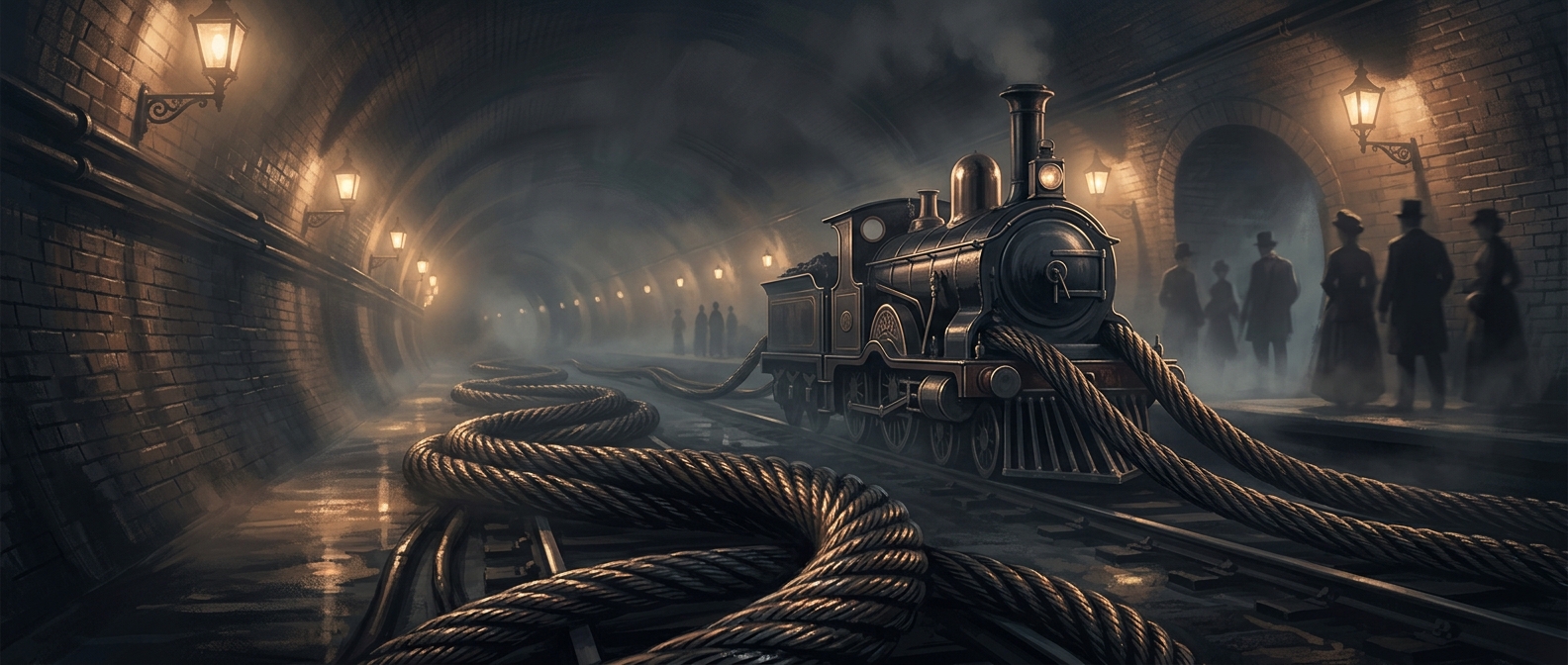
The engine would turn large drums that moved a long, continuous rope through the tunnel. A train carried a grip—a mechanism that could clamp onto the moving cable to be pulled, then release it when the train needed to stop. The train itself had no onboard engine, so there was no locomotive exhaust in the tunnel.
A mechanical clothesline with demanding logistics
The cable could not simply run at one unchanging speed from end to end. Trains had to stop at stations while the rope kept moving, so crews would release the grip and later catch the cable again. The system also needed the rope to stay properly tensioned and aligned around bends and equipment. A failure in the shared cable could affect every train using that stretch.
That made cable traction a tradeoff, not a straightforward cure for smoke. It moved the power source out of the train, but replaced many individual locomotives with a large, tightly coordinated mechanical system. London ultimately used steam trains on its early underground railway; the cable idea remained an alternative rather than the method that defined the network.
The striking image is that an underground train could have been pulled by a rope it never carried—one driven by machinery elsewhere, like a clothesline running through the city.