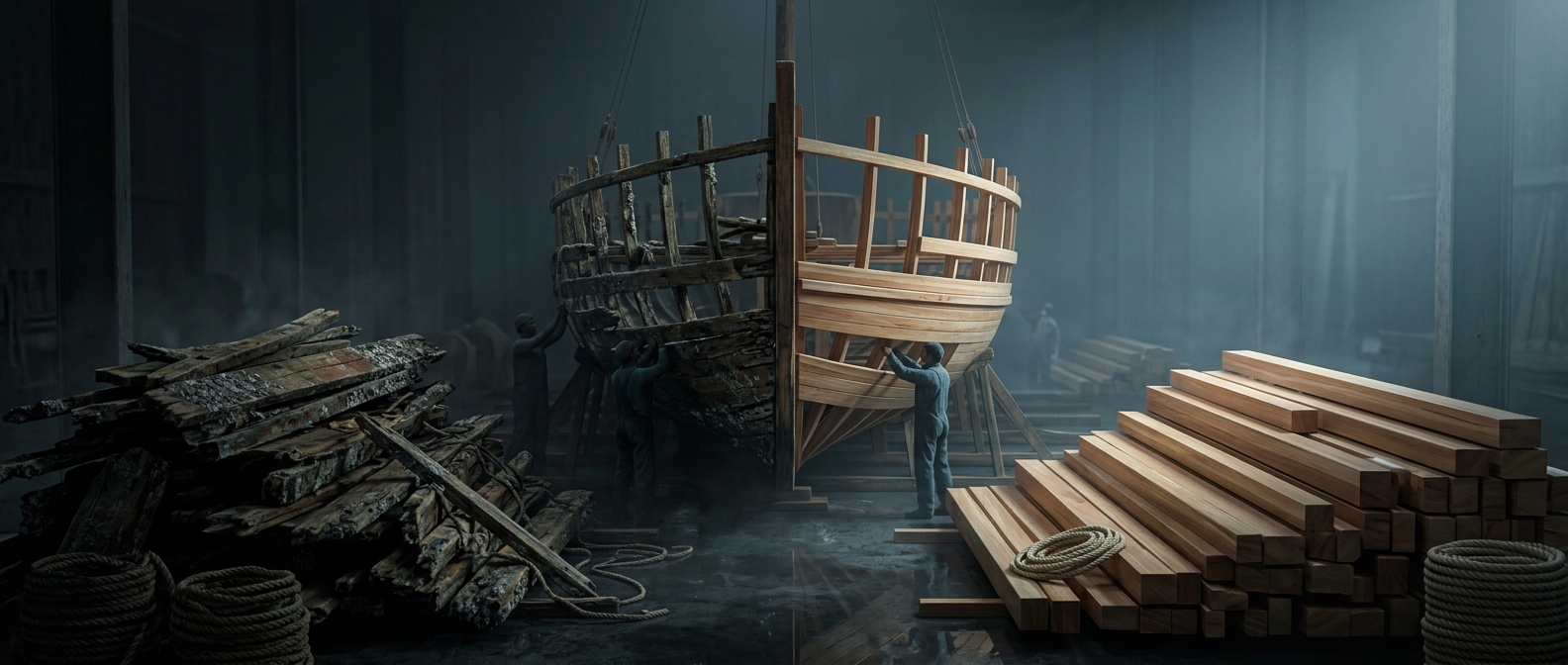
Why a Repaired Ship Can Still Seem Like the Same Ship
The puzzle turns on the fact that “same” can mean more than one thing. It can mean made of the same material, or it can mean the continuing object in a recognizable history. Those meanings usually agree: a ship keeps most of its planks as it sails. Replacing them one at a time separates the two.
In ordinary life, we often follow continuity of use and history. The vessel is repaired, remains in service, and is treated as the ship that came in for repairs. No single replacement marks a clear moment when it becomes a different ship. Its identity seems to travel along the chain of changes.
Two Different Tests for Identity
A material test asks whether the original planks remain. A continuity test asks whether the ship developed from the earlier vessel through an unbroken sequence of repairs and use. Either test can sound reasonable, but they answer different questions. The first tracks components; the second tracks an object’s ongoing story.
The tension sharpens if the removed planks are later assembled into another ship. That vessel has the original material, while the repaired vessel has the uninterrupted history. Calling both the one original ship would stretch “same” in two directions at once. The puzzle does not supply a hidden fact that settles the dispute; it exposes the criteria we bring to the word.
Why the Distinction Matters
This way of thinking appears whenever something changes gradually. A restored building, a repaired heirloom, or a familiar tool may retain its identity for us even after much of its matter has been replaced. What we preserve may be less a fixed inventory of parts than a continuous relationship between the object, its past, and its use.
The ship’s identity therefore depends on what the question is asking us to preserve: its original wood, or the uninterrupted vessel that people kept sailing.