How a small asteroid can keep a companion
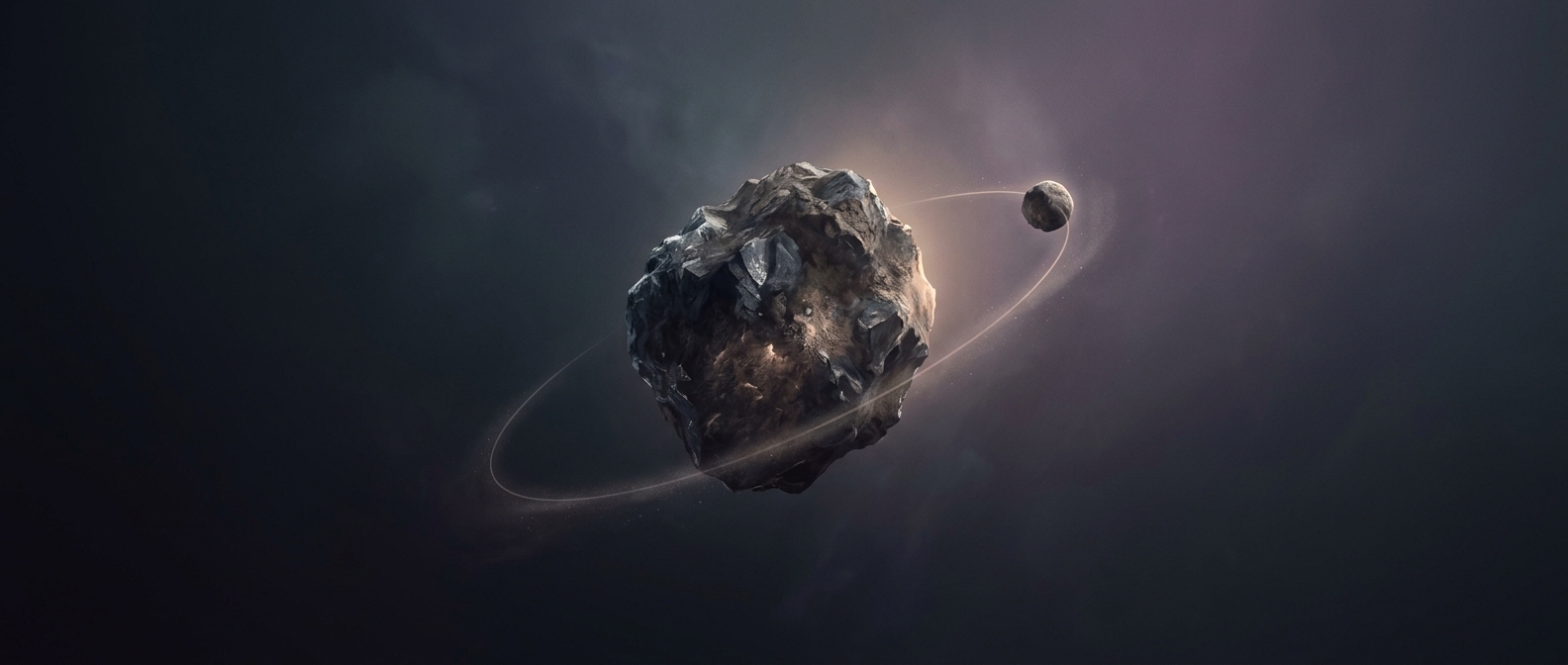
An asteroid does not need strong gravity to have a moon. It needs enough gravity to bend a nearby object’s path, and the object must be moving slowly enough relative to the asteroid to remain bound rather than fly past. If it follows a stable orbit, the two bodies circle their shared center of mass—the point around which both move.
Speed and distance set the balance
Gravity weakens quickly with distance, so a companion has to stay relatively close. Its sideways motion matters, too: at the right speed, it continually falls toward the asteroid but keeps missing it, tracing an orbit. Too much speed, or a close pass that gives it a strong shove, can send it away; too little sideways motion can lead to a collision.
That balance can be delicate because asteroids are small and their gravitational pull is slight. The Sun’s gravity and disturbances from other bodies can also disrupt a distant or loosely bound companion. A lasting moon therefore tends to occupy a stable region close enough to its asteroid that the asteroid’s pull can keep it in orbit.
A system smaller than a planet
Some asteroid companions may be fragments produced when a larger body breaks apart or when an impact knocks material loose. If debris remains near the main asteroid and settles into a stable orbit, it can become a natural satellite. The result is a miniature two-body system: neither object needs to be a planet, and the smaller one can still have a moonlike orbit around the larger.
The key is not the asteroid’s size alone, but the combination of gravity, distance, and motion that lets a companion keep missing its rocky neighbor.