Why the astronauts came home to a trailer
Apollo 11’s quarantine was a precaution against a risk no one could confidently rule out: that lunar material might carry organisms capable of harming people or Earth’s environment. The crew had brought Moon dust and rocks back with them, so simply landing safely in the ocean did not end the mission’s biological-safety problem. NASA needed to keep the astronauts and their samples contained while checking for signs of contamination.
A mobile room built around containment
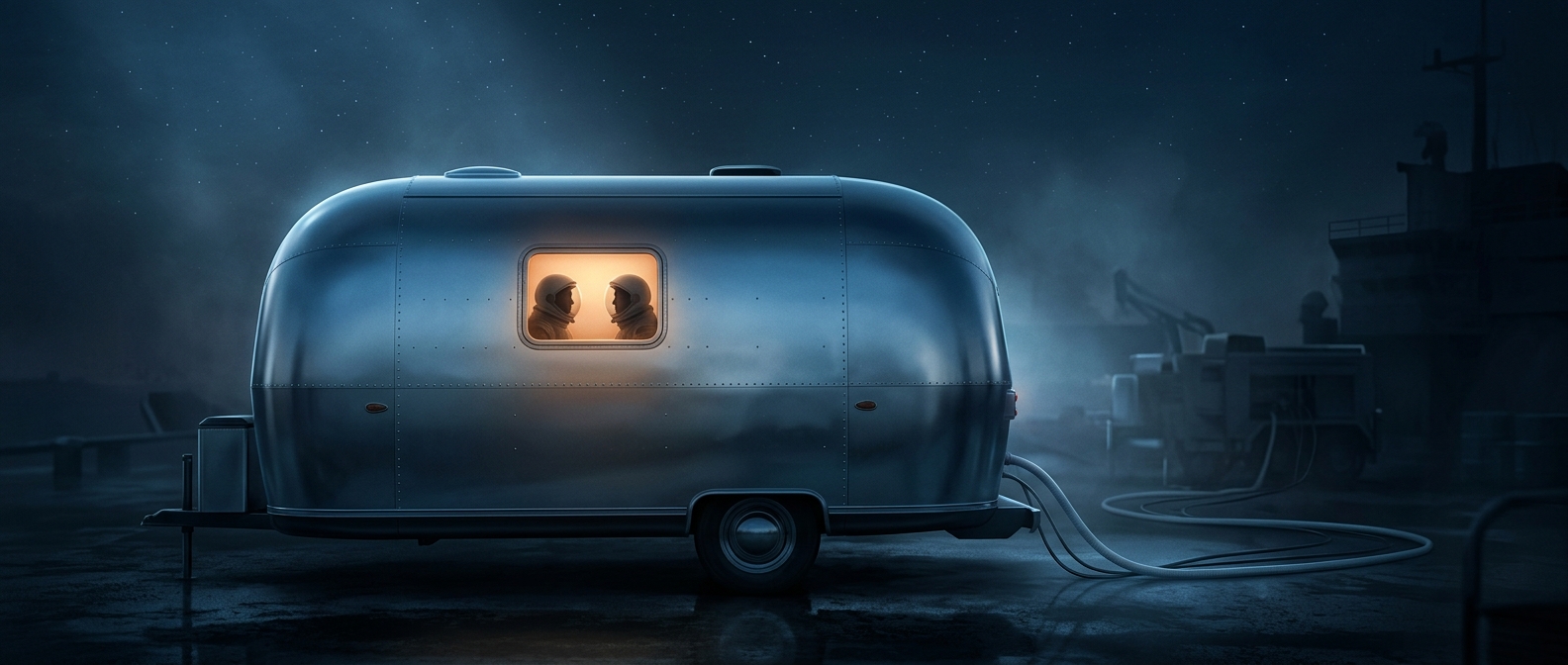
The solution was a Mobile Quarantine Facility, or MQF: a sealed, transportable living space that could be moved from the recovery ship to land and then to NASA’s Lunar Receiving Laboratory in Houston. The astronauts entered it after being brought aboard the aircraft carrier. Air was filtered, and staff interacted with the crew through controlled procedures rather than treating the unit like an ordinary passenger cabin.
The trailer was not a comfortable extension of the spacecraft. It had sleeping and living areas, but its compact layout had to support three people, basic daily needs, medical observation, and communication while limiting the chance that anything could escape. Moving the whole facility also avoided repeatedly transferring the crew into ordinary buildings during the initial quarantine.
What the quarantine accomplished
Inside the facility, doctors monitored the astronauts, while laboratory teams examined lunar samples and looked for biological activity. The process was designed to protect Earth if the Moon proved hazardous—not because NASA had evidence that it was. When the quarantine period ended without signs of lunar contamination, the astronauts were released.
The MQF made an unusual transport problem manageable: the returning crew, their samples, and the containment system could travel together. That small trailer was therefore part living quarters and part mobile laboratory boundary, carrying the uncertainty of the first human return from the Moon all the way to the place where it could be investigated.