Why flight advanced so quickly
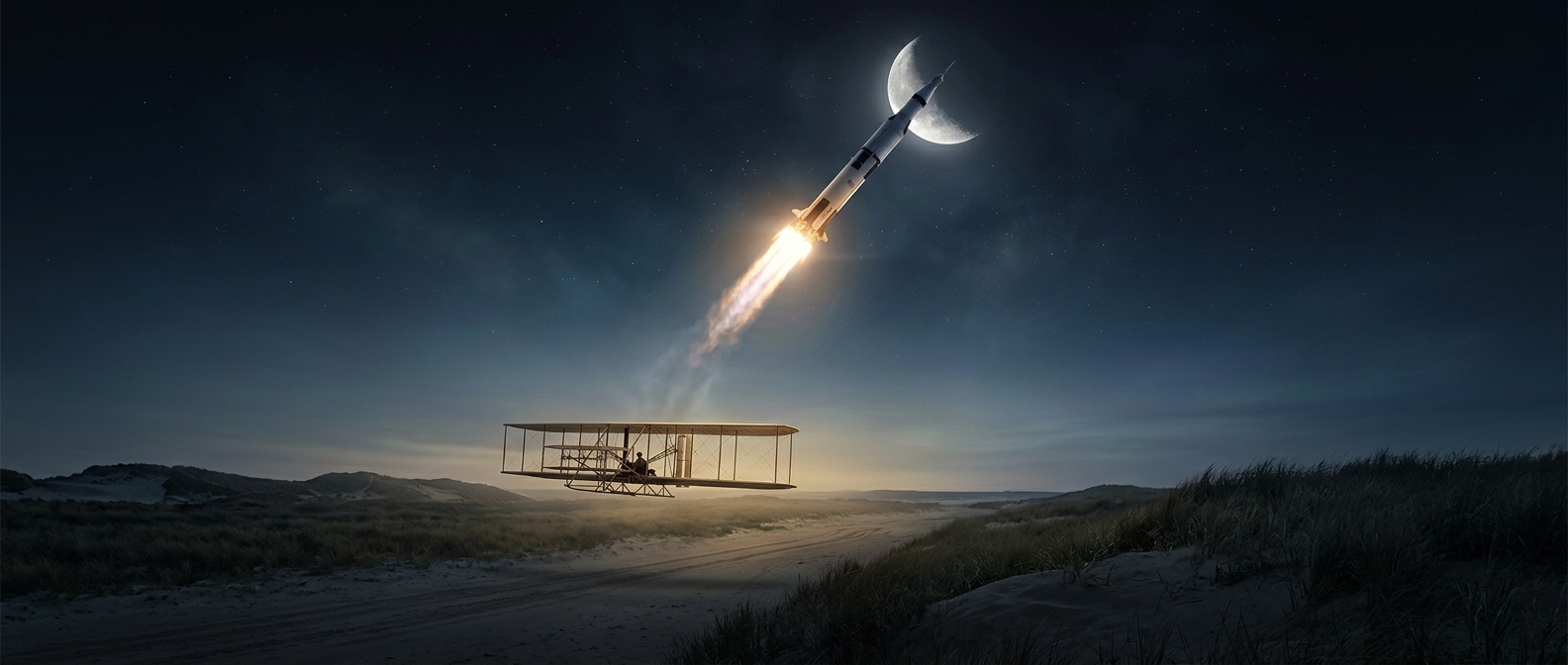
The Wright brothers’ 1903 flight and Apollo 11’s 1969 Moon landing were not two versions of the same engineering problem. The first challenge was to keep a powered aircraft controllable in the air. The second was to accelerate a spacecraft fast enough to escape Earth, steer it across space, and bring it down safely at a precise destination.
What connected them was a growing ability to make machines move predictably. Early airplanes showed that powered flight depended not just on an engine, but on controlling lift, balance, and direction. As aircraft improved, engineers gained practical experience with lightweight structures, propulsion, and piloting. Each advance made the next set of problems easier to tackle.
Rockets changed the scale of the journey
An airplane stays aloft by moving through the atmosphere: its wings use airflow to generate lift. A rocket works differently. It carries both fuel and the oxygen needed to burn it, so it can keep producing thrust beyond the atmosphere. That makes spaceflight possible, but demands far more energy and careful control than crossing a field or an ocean.
The shift also changed what “guidance” meant. A pilot can respond to what is visible outside the aircraft. A spacecraft must follow a planned path using instruments and onboard systems, adjusting its course without relying on ordinary aerodynamic control. Reaching the Moon required not only a powerful launch, but accurate navigation over a long distance and a controlled landing.
Materials and control made ambition practical
Greater power alone would not have been enough. Flight and spaceflight both depend on structures that are strong without being too heavy, and on systems that remain reliable under demanding conditions. Better materials helped carry equipment and people while limiting mass; improved guidance helped keep the vehicle on its intended path.
That is why the 66-year span is more than a story of bigger engines. It marks a change from learning how to control a machine in the air to coordinating propulsion, navigation, structure, and landing beyond Earth. The Wrights had to keep an aircraft flying; Apollo had to make every stage of a journey work well enough to reach another world.