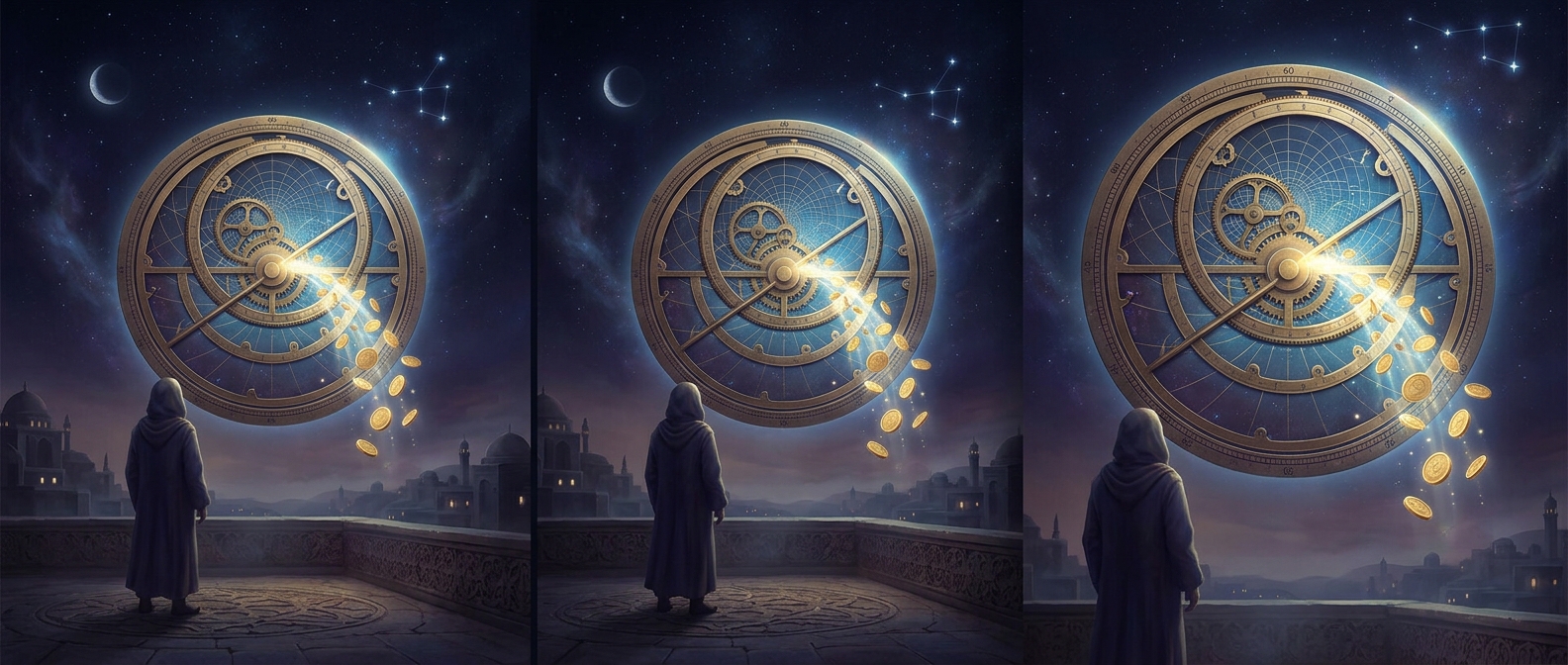
How Solar-Arc Directions Move a Birth Chart
Solar-arc directions are a timing technique in astrology. They begin with a symbolic clock: astrologers treat roughly one day of planetary motion after birth as corresponding to one year of a person’s life. The Sun’s position on that later day is compared with its position at birth. The difference between them—the “solar arc”—is then used as a common shift for the chart’s other points.
That shared shift is the method’s defining feature. Rather than calculating a separate yearly motion for each planet, the astrologer advances the chart’s planets and key angles, such as the Ascendant, by the same amount. The result is a directed chart, which can be compared with the original birth chart.
What the Shift Is Meant to Show
Astrologers look for moments when a shifted point forms a significant angle, or aspect, with a point in the birth chart. For example, a directed planet might reach the same zodiac degree as the natal Midheaven, an angle associated in astrology with public life and vocation. Such a contact may be interpreted as a period when that theme becomes prominent.
The technique therefore produces symbolic timing, not a date guaranteed to bring a particular event. Its distinctive simplicity also creates a clear interpretive tradeoff: every point advances together, so the method emphasizes relationships between the shifted chart and the birth chart rather than each planet’s individual motion. A single calculated arc can bring several different parts of the chart into focus at once.