A flower’s landing place makes an abstract teaching personal
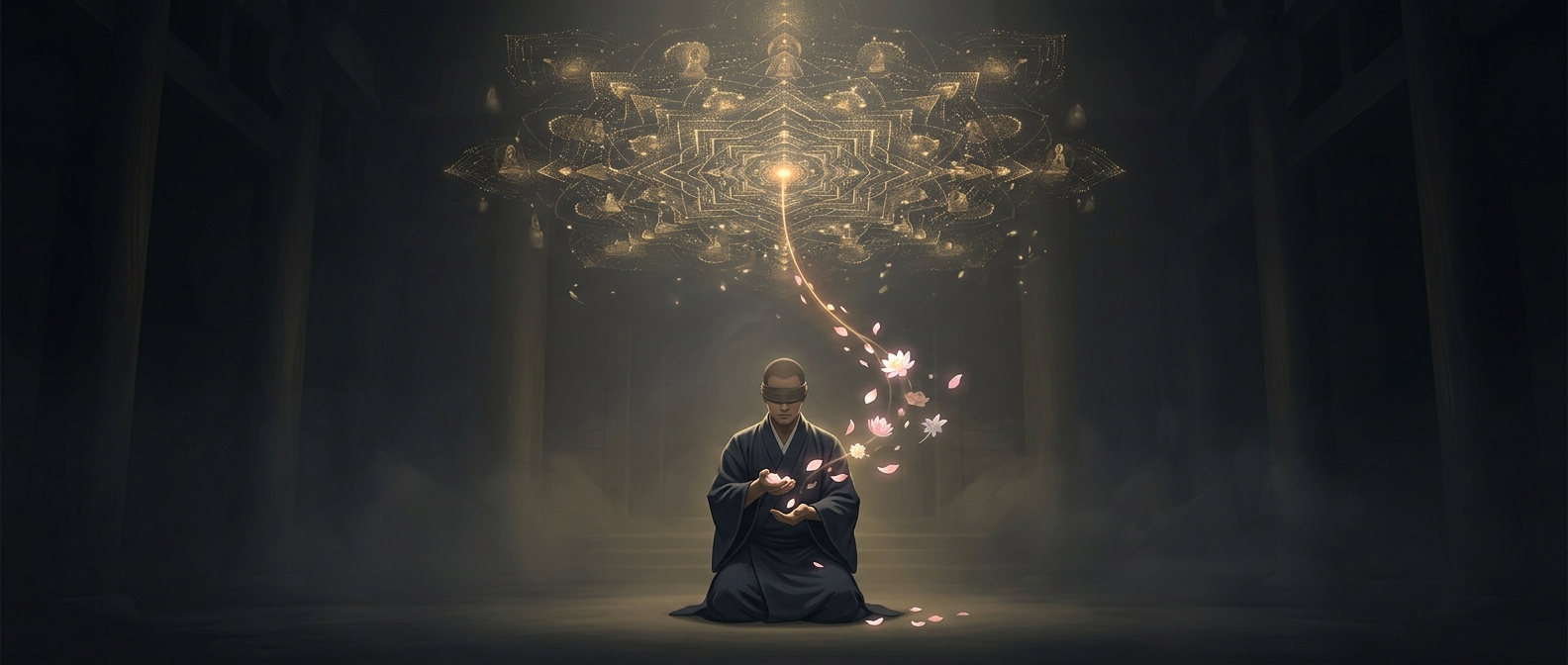
In Shingon Buddhism, a mandala is more than a diagram of sacred figures. It presents the Buddhist cosmos as an ordered field of awakened beings, each associated with particular forms of wisdom and practice. For someone new to the tradition, that world can be difficult to approach as a whole. Kechien Kanjō gives the encounter a personal point of entry: the initiate casts a flower, and its landing place identifies a deity with whom the person is ritually connected.
The blindfold matters because the choice is not meant to be a deliberate selection based on preference or prior knowledge. The ritual lets chance determine the point of contact, turning an unfamiliar mandala into a specific relationship rather than a set of symbols to inspect from a distance.
What the connection means
The Japanese name Kechien Kanjō refers to an initiation that establishes a connection, or karmic tie, with a Buddha or other revered figure. “Karmic” here belongs to Buddhist religious understanding: it describes a bond with consequences for a person’s spiritual path, not a measurable force. The deity selected through the flower’s fall can serve as a focus for devotion and practice.
That does not mean the initiate has mastered a teaching or received instant enlightenment. The ceremony marks a beginning. Its purpose is to bring the novice into a relationship with the mandala and the tradition, so that later learning and practice have a concrete center.
From cosmic order to a first step
Kūkai, the monk associated with the formation of Japanese Shingon Buddhism, formalized the rite as a way to make esoteric teaching approachable through ritual experience. Instead of asking a novice to understand the entire symbolic system at once, the ceremony uses one simple action to locate them within it. The flower’s landing place turns an immense sacred map into a single, memorable starting point.