Why radioactive decay makes a reliable clock
An unstable atomic nucleus can transform by releasing particles or energy. The transformation happens at a random moment: nothing in the atom’s visible surroundings tells us which nucleus will decay next. But each nucleus has a consistent probability of decaying during a given span of time. That probability is characteristic of the isotope—the particular form of an element with a specific number of neutrons.
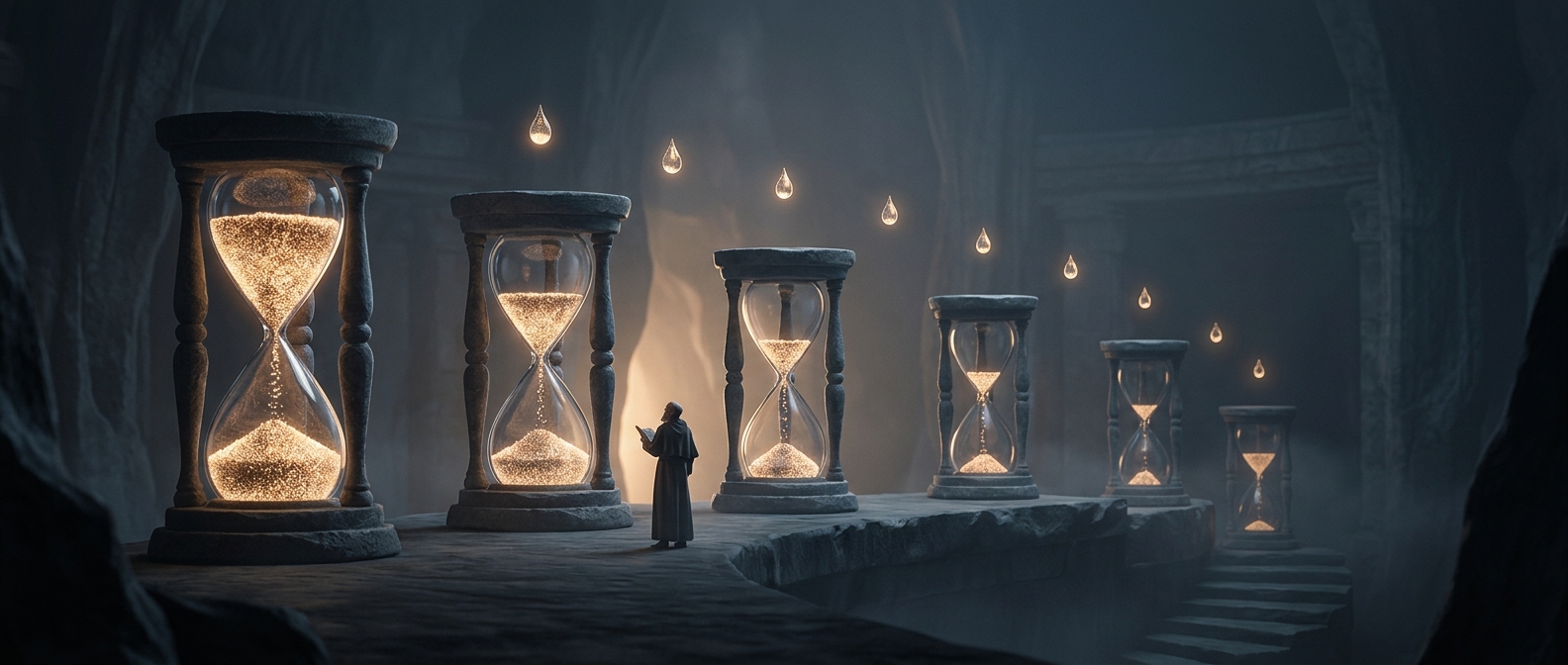
In a large sample, those individual chances combine into a predictable curve. The fraction that remains falls by half over each half-life: half of what is present after one half-life, then half of that remainder after the next. The decline is steady in a statistical sense, not because atoms take turns or follow a shared timer. A small sample can fluctuate noticeably; a huge population follows the expected pattern much more closely.
Turning the pattern into elapsed time
Scientists use this decay curve by comparing the amount of a radioactive isotope with the amount of its decay product. If they know how the sample began—for example, that a mineral trapped a particular isotope when it formed—the measured proportions can indicate how much time has passed. The isotope’s known half-life supplies the scale, much as the markings on a clock face do.
The clock is dependable because the decay probability is built into the nucleus, rather than set by ordinary changes in temperature or pressure. But reading it still requires care: scientists must account for whether the sample gained or lost either substance and whether its starting conditions are understood. The striking result is that an event no one can schedule for a single atom becomes a useful measure of time when enough atoms are counted together.