A Short Schedule Shifted the Work From Building to Reworking
With much of Ocarina of Time’s technical foundation already available, the team did not have to start every part of Majora’s Mask from scratch. Reusing the engine, character models, animations, and other assets reduced the time spent creating basic building blocks. But familiar pieces still had to serve a different adventure: the developers could spend more of their effort changing how the world behaved and what players did in it.
That distinction matters. Reusing a character model is relatively straightforward; making that character feel like part of a new story requires new dialogue, routines, and interactions. Majora’s Mask turns many returning characters into residents of Termina, whose lives unfold on a shared schedule.
The Three-Day Cycle Made Time the Main System
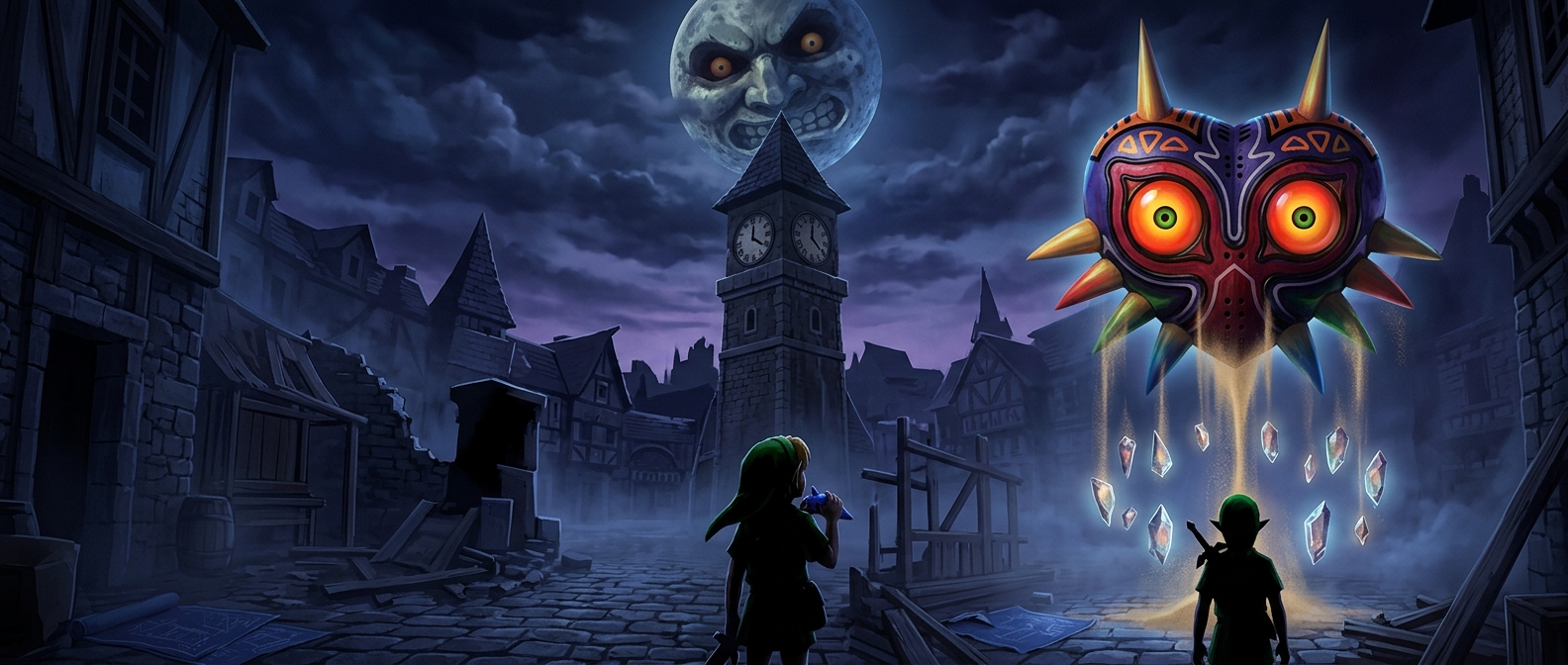
The game’s central device is a repeating three-day period. Characters follow routines as the hours pass, and events can depend on where the player is at a particular time. When the cycle ends, the world resets. Link keeps important knowledge and certain forms of progress, but many short-term events begin again.
That structure gives repetition a purpose: players can learn a character’s schedule, then use another attempt to be in the right place at the right moment. Instead of requiring an entirely new set of assets for every branch of the adventure, the same town and cast can support many different outcomes through timing and interaction.
The tight production window did not mean the game was merely a smaller copy of its predecessor. Reusing familiar components helped make room for a distinct design—one in which the player’s most valuable tool is often knowing what will happen next. A resident encountered in the wrong place or at the wrong hour may be easy to miss; on the next cycle, that knowledge changes what Link can do.