Why Astrology Gives the Sun and Moon a Different Status
In astrology, the Sun and Moon are called luminaries—the two bodies understood to provide light—rather than planets. That distinction is more than a naming preference: it separates them from the planets whose apparent motion can include retrograde periods.
Astrology tracks celestial bodies against the zodiac, a band of sky divided into signs. Most of the time, planets appear to move forward through that band. At intervals, however, a planet seems to pause and drift backward before resuming its usual direction. Astrologers call that apparent reversal retrograde motion.
Why the Luminaries Don’t Go Retrograde
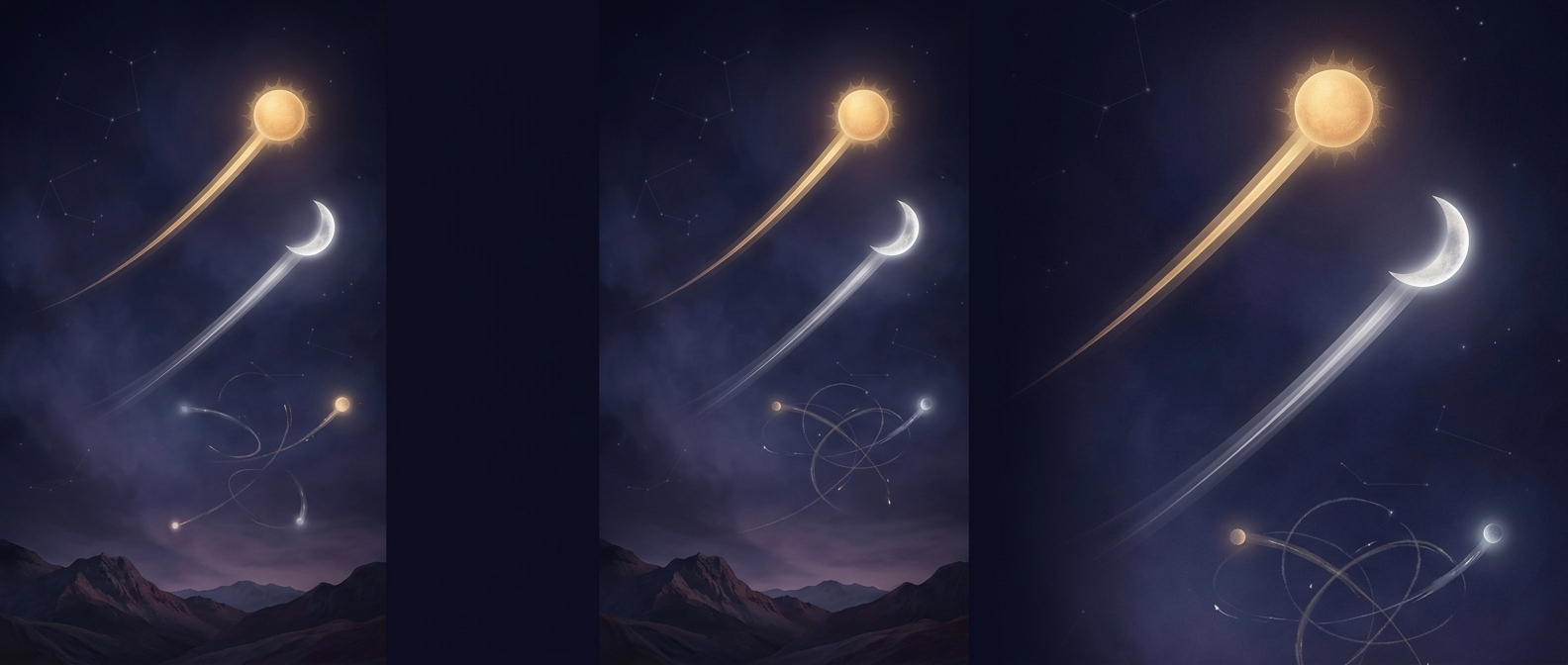
The apparent backward drift is a perspective effect. As Earth and another planet travel around the Sun at different speeds, their changing positions can make the planet seem to move backward against distant stars, much as a passing car can appear to slide backward relative to a slower vehicle. The planet has not actually reversed its orbit.
The Sun and Moon do not show that same pattern in the zodiac. The Sun progresses through it over the course of a year; the Moon moves through it much faster, completing a circuit in about a month. Their paths are treated as consistently forward, so astrologers do not mark them retrograde.
That makes the distinction useful in astrological interpretation: a retrograde period can be assigned to a planet as a temporary change in its apparent motion, while the Sun and Moon remain steady reference points in the chart. The Moon may change signs rapidly, but it does not double back.