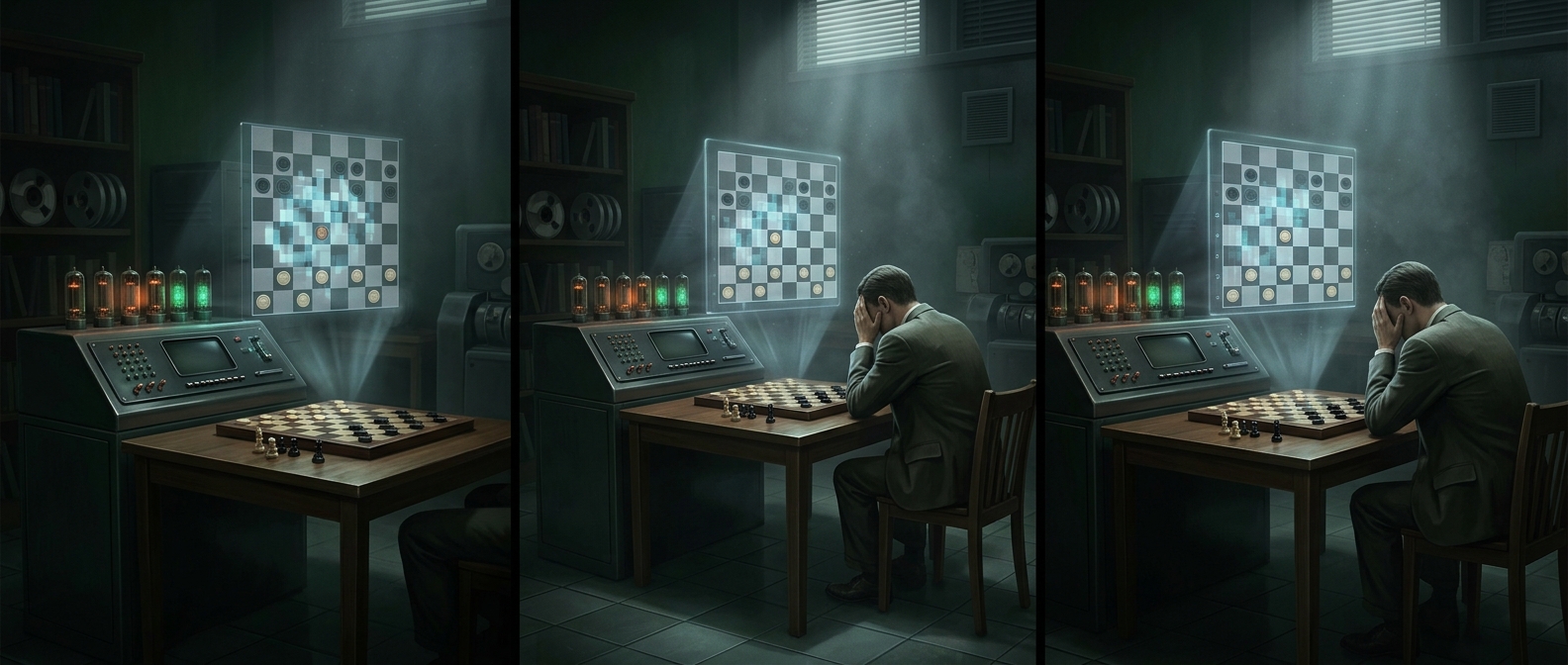
Turning a Checkers Board Into Computation
To play checkers, a computer needs more than a list of legal moves. It must represent which squares are occupied, whose pieces are where, and whether each piece is a regular checker or a king. After each move, the program has to update that internal picture and determine what moves are possible next.
Christopher Strachey’s 1951 program for the Ferranti Mark 1 did this well enough to play a complete game at a practical pace. That was a substantial step beyond a machine merely calculating an answer to a fixed problem: the program had to respond to an opponent, whose choices continually changed the position.
Choosing a Move Without “Thinking” Like a Person
A game-playing program can compare possible moves by looking ahead: if it makes one move, what might the opponent do, and what position would follow? It can then use simple rules to judge whether a position is favorable—for example, by considering pieces captured or the prospect of reaching a king. Such a score is not human understanding; it is a way to rank the options the program can examine.
The challenge was to make that process fit the computer’s limited speed and capacity. Searching every possible continuation would quickly become too demanding, so the program had to keep its analysis manageable while still choosing sensible moves. Playing a full game at reasonable speed showed that a computer could carry a rule-governed task through a changing series of decisions, not just perform isolated arithmetic. That made Strachey’s checkers program an early, concrete demonstration of what would come to be called artificial intelligence.