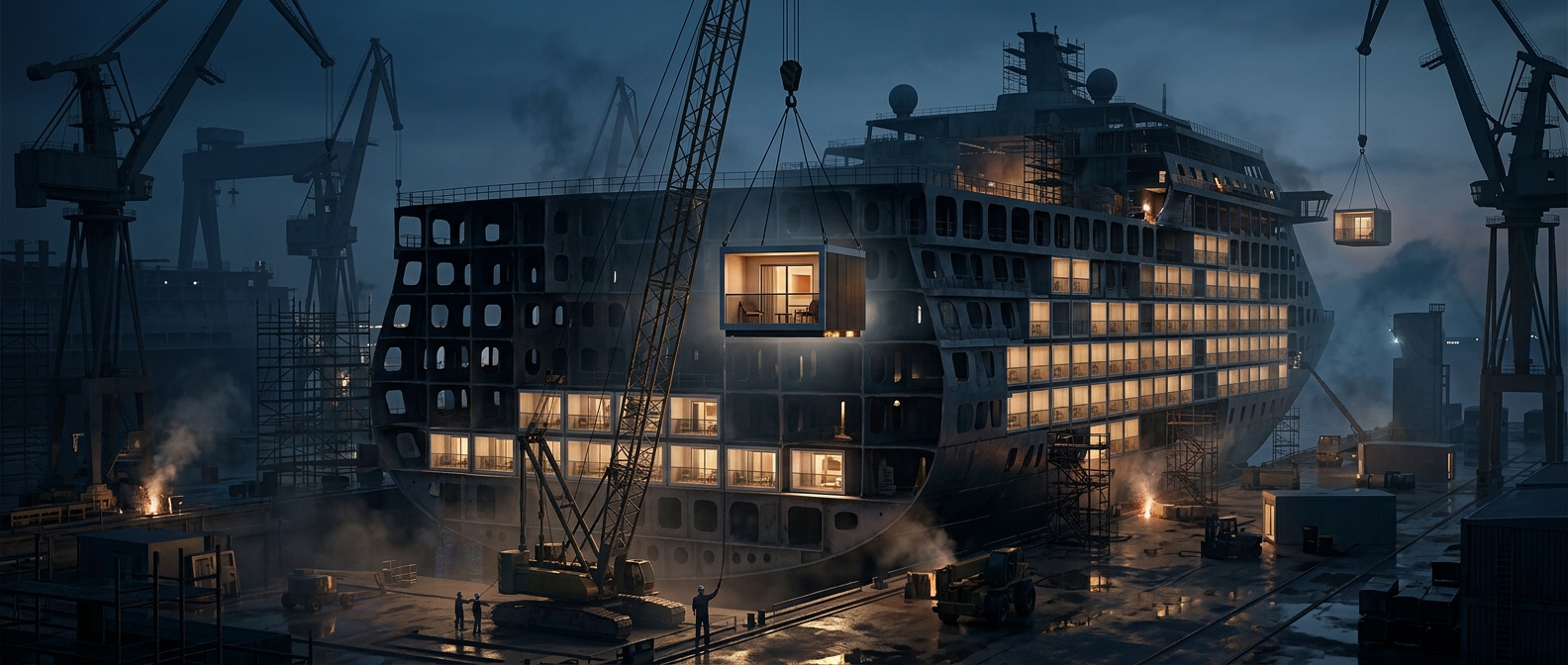
How a cabin becomes part of a ship
A cruise ship is not built as one continuous shell with every room finished in place. Its interior can be assembled from prefabricated cabin modules: room-sized units made in a factory, where workers can install furnishings and run pipes and wiring before the cabins reach the shipyard.
That changes the order of work. While the hull is being built, cabin modules can be prepared elsewhere. Once the ship’s structure is ready, cranes move the modules into position, often through large openings that will later be closed. The modules are secured to supports, then connected to the ship’s water, drainage, electrical, and ventilation systems. Those connections are crucial: a cabin may arrive looking complete, but it still has to function as part of a much larger network.
Why build rooms this way?
A shipyard is a difficult place to finish hundreds of small rooms. Workers share tight spaces with heavy construction, equipment, and other trades. Building cabins in a factory makes the work easier to organize and lets different parts of the ship progress at the same time. Repeating a standard room design also helps keep fittings and connections consistent.
The tradeoff is that the modules must fit the ship precisely. Their dimensions, lifting points, and utility connections have to match the plans; once the hull is closed, access for moving a large unit becomes limited. This is why the installation sequence matters as much as the cabin’s interior finish.
For passengers, the result is an ordinary-looking room with an unusual construction history: much of it was completed before the ship around it was ready.