Why an old screen can feel faster
In a split-second game, the important delay is not just how quickly a player presses a button. It is how long the whole chain takes: the console reads the input, the game updates, and the display shows the result. If the screen adds even a little waiting, a player may see a jump or attack later than the game has calculated it.
A CRT (cathode-ray tube) makes its picture by sweeping an electron beam across a phosphor-coated screen. It can show an incoming video signal without first doing the scaling and image processing common in many flat-panel TVs. Those steps can add display latency—the time between receiving a picture and showing it. The amount depends on the particular screen and settings; a modern display is not automatically slow.
Familiar timing matters
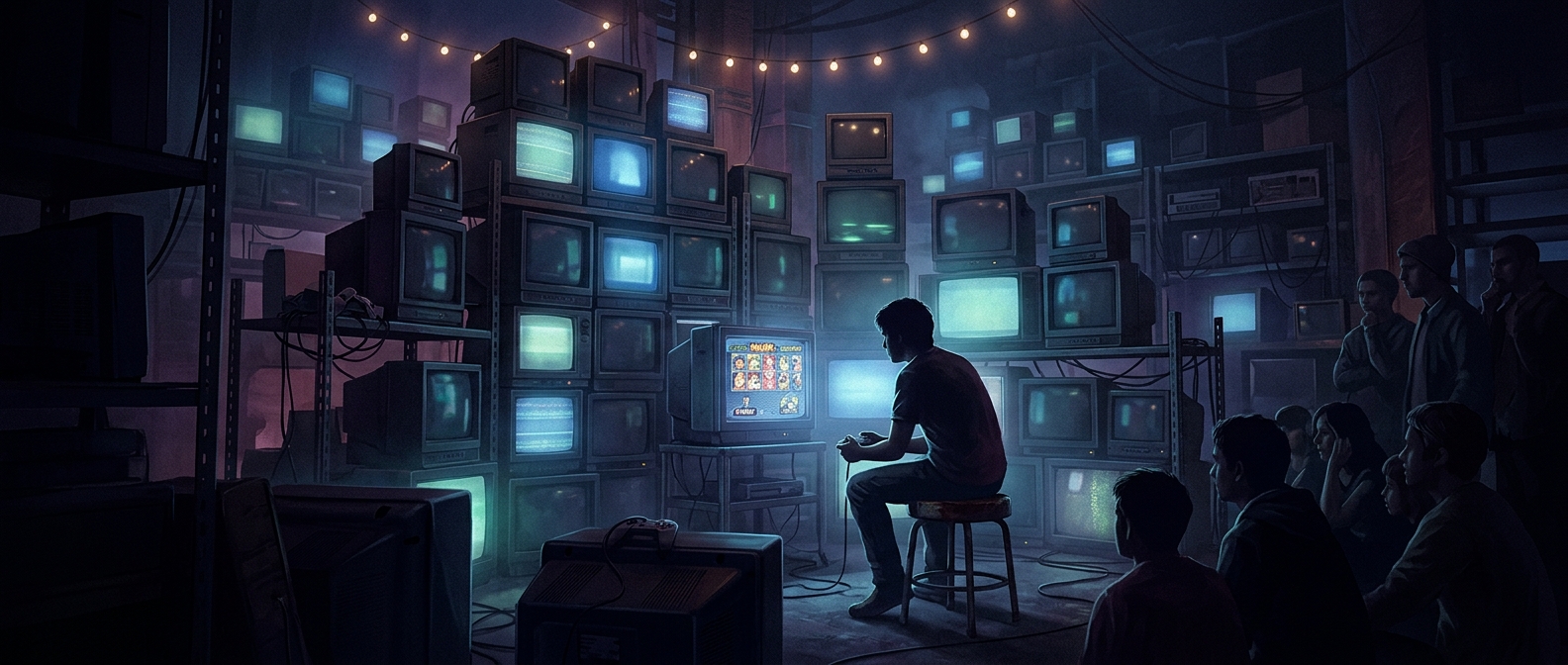
Many older Smash games were designed for the video systems of their era, and competitive setups often use the original console’s analog video output with a CRT. That avoids adding a modern TV’s processing to the chain. It also gives players a consistent setup: when a move appears on screen at a familiar moment, timing practiced over thousands of matches remains easier to trust.
The tradeoff is substantial. CRTs are bulky, heavy, and increasingly hard to find, while newer screens are easier to transport and set up. For a casual match, the difference may be unnoticeable; at the highest level, a small timing shift can change whether a defensive move comes out in time. The old TV’s appeal is not nostalgia alone: it is a way to keep the screen from adding uncertainty to an already precise game.