How a rhythm game turns steps into exercise
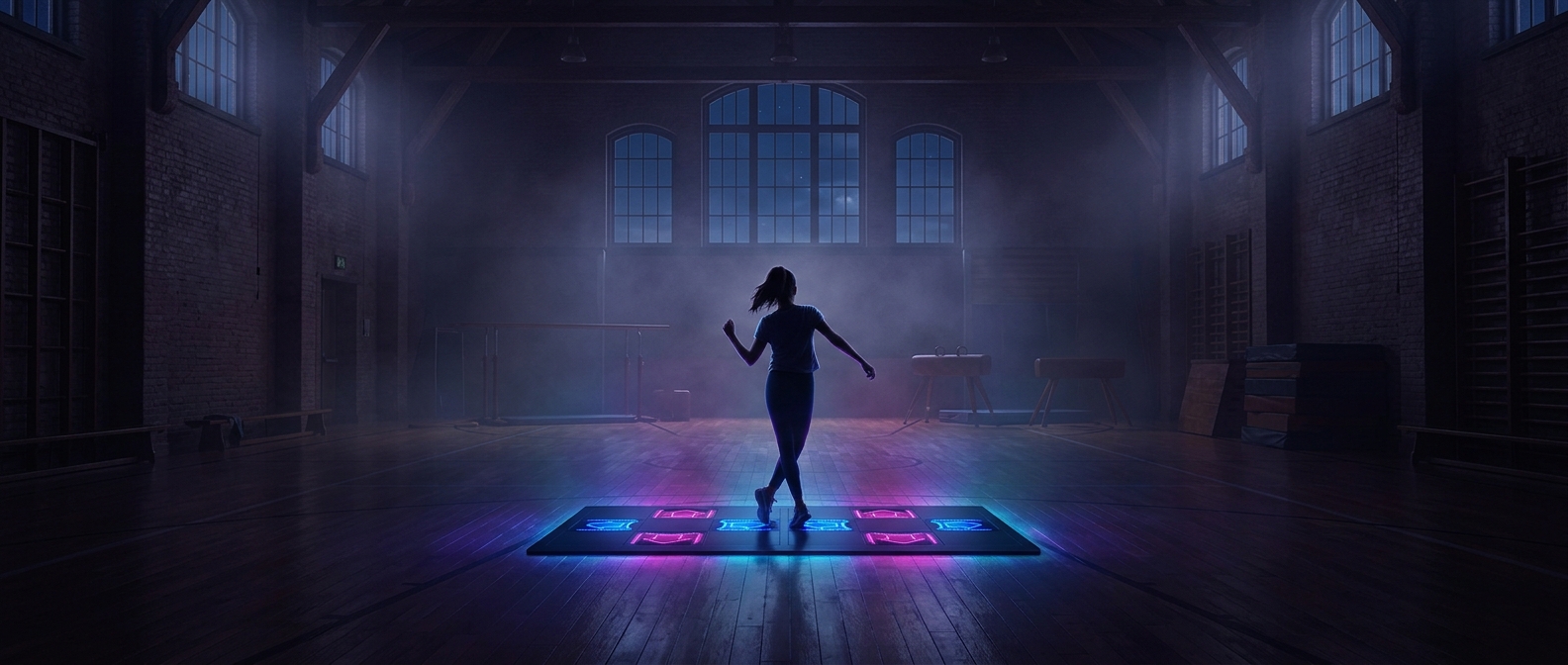
Dance Dance Revolution asks players to match on-screen arrows by stepping on corresponding directions on a floor pad. The arrows arrive in time with music, so the player must read the pattern, move quickly, and stay on beat. In a school gym, that familiar game loop can turn repeated stepping into sustained physical activity without requiring students to learn a dance routine first.
Feedback keeps players moving
Each step produces an immediate result: hit the arrow at the right moment and the game rewards the player; miss it and the mistake is visible in the score. That quick feedback gives movement a clear goal. Songs, rising difficulty, and the chance to improve a score can make students focus on the next sequence rather than on the fact that they are exercising.
The game also makes effort legible. As patterns speed up or grow more complicated, players have to move more often and coordinate their feet under pressure. The challenge is adjustable, though: a song or setting that feels manageable to one student may be demanding for another.
A game is not a whole PE program
Arcade-style pads bring practical limits: students need room, equipment, and turns, and the game mainly trains movement in place rather than the full range of activities a physical-education class might cover. Its value is more specific. For teenagers who might resist a conventional exercise drill, a score to chase and a beat to follow can provide an immediate reason to keep stepping.
That is the useful twist: the machine does not make movement disappear—it gives movement a game-shaped purpose.