One button turns the room into a route
In VVVVVV, the central movement decision is not how high to jump, but when to reverse the pull of gravity. A press sends the character toward the opposite surface; left and right still control horizontal movement. That removes the familiar platform-game arc, where a player chooses a jump’s height and landing point, and replaces it with a stark choice between floor and ceiling.
The change makes both surfaces part of the same path. A safe strip of floor can lead into a dangerous ceiling, and a flip can carry the character across a gap without clearing it in a jump. The player is constantly judging which surface will be safe next—and whether there is room to reach it.
Spikes turn timing into the challenge
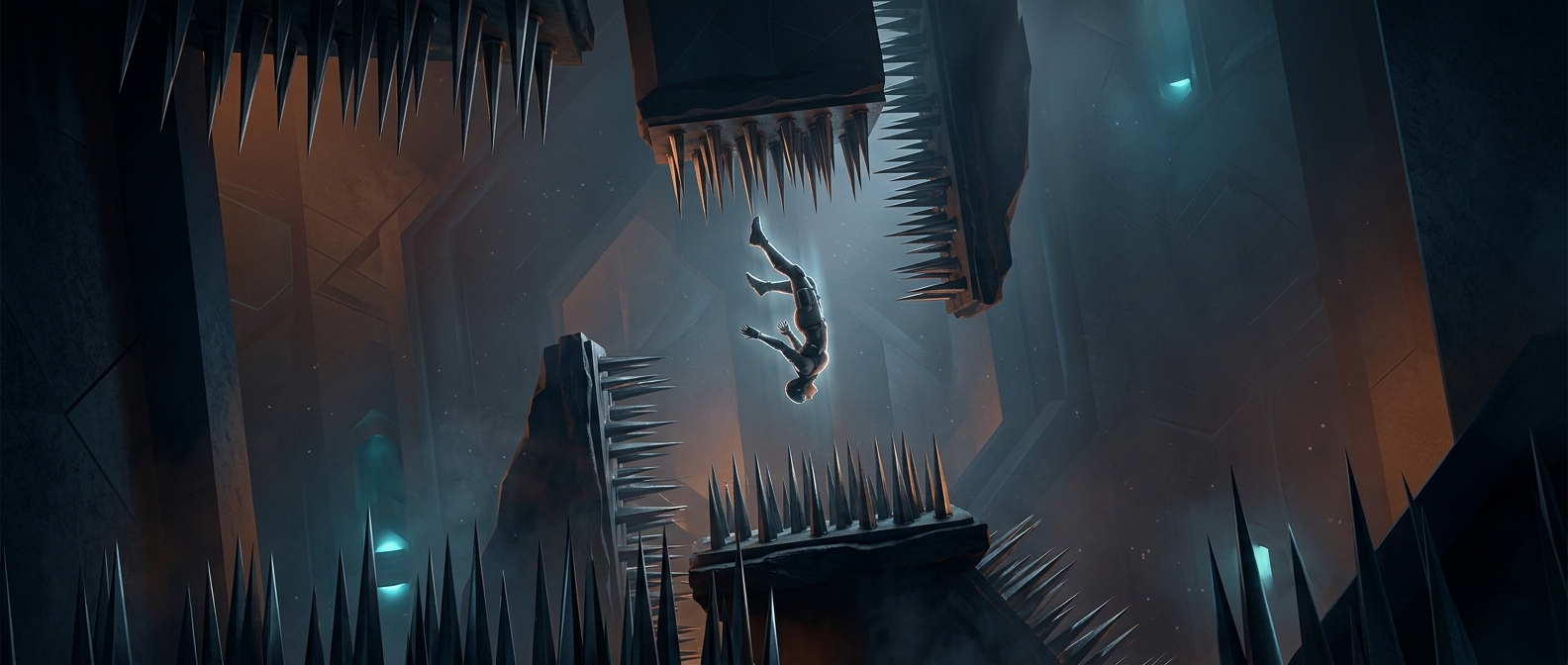
Because the character cannot simply hop over an obstacle, hazards reshape the route. Spikes on one surface can force a reversal; spikes on the other can make that reversal dangerous. In tight passages, flipping too early or too late means arriving at a hazard rather than a landing spot. The challenge comes from reading the room and timing a simple input, not from mastering a complicated set of moves.
That constraint also gives the levels a clear design language: walls and ceilings are not just boundaries around a platforming course. They are possible destinations. A room can feel like a small puzzle in which the player alternates between two tracks, with each safe landing setting up the next decision.
A simple control, many consequences
The one-button mechanic is easy to understand, but it changes how players interpret space. Instead of asking, “Can I jump over that?” they ask, “Which surface can I reach, and what will be waiting there?” A room full of spikes becomes a sequence of choices about direction and timing—a route drawn across both the floor and the ceiling.