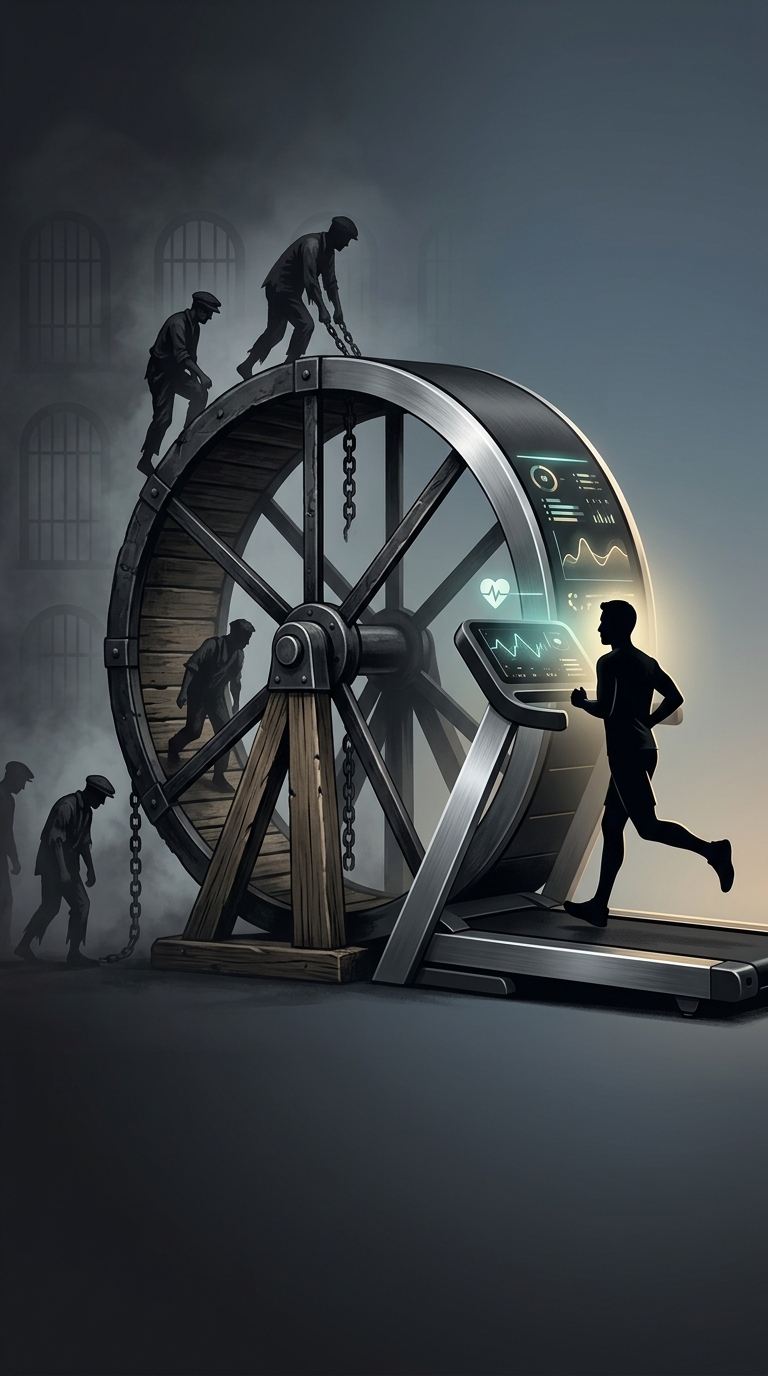
The Treadwheel Turned Punishment Into Work
William Cubitt’s design answered a practical question for prison authorities: how could confinement impose hard labor even when there was little useful work to assign? His treadwheel gave them an answer. A row of prisoners stepped on moving boards fixed around a large wheel; their weight kept it turning, and the rotation could drive machinery such as a mill or pump.
The machine did not carry prisoners forward like a modern exercise treadmill. They had to keep climbing in place to avoid slipping backward. The wheel converted that repetitive effort into power, while its steady motion made the labor easy for guards to supervise.
Why the Wheel Fit Prison Discipline
In early 19th-century Britain, some prison reformers and officials treated labor as a way to impose order and discourage future crime. The treadwheel suited that outlook because it combined exhaustion with routine: prisoners performed the same demanding movement for hours, under institutional control. Whether the work produced flour or lifted water mattered less to the punishment than the effort required to keep the wheel moving.
That design also exposed a tension in penal reform. A device could be presented as productive labor while still making bodily hardship the point. The wheel’s defining feature was not that it took prisoners somewhere, but that it made their effort useful to the institution while leaving them exactly where they began.