Leonardo’s military designs were also a bid for patronage
In Renaissance Italy, rulers hired engineers as well as artists. Leonardo da Vinci understood that a court might value a person who could strengthen a city’s defenses or help win a campaign. When he sought work from Milan’s ruler, Ludovico Sforza, he presented himself as capable of designing military equipment, alongside his skills in art and architecture. His notebooks show how he explored that practical side of his ambitions.
Sketches aimed at battlefield problems
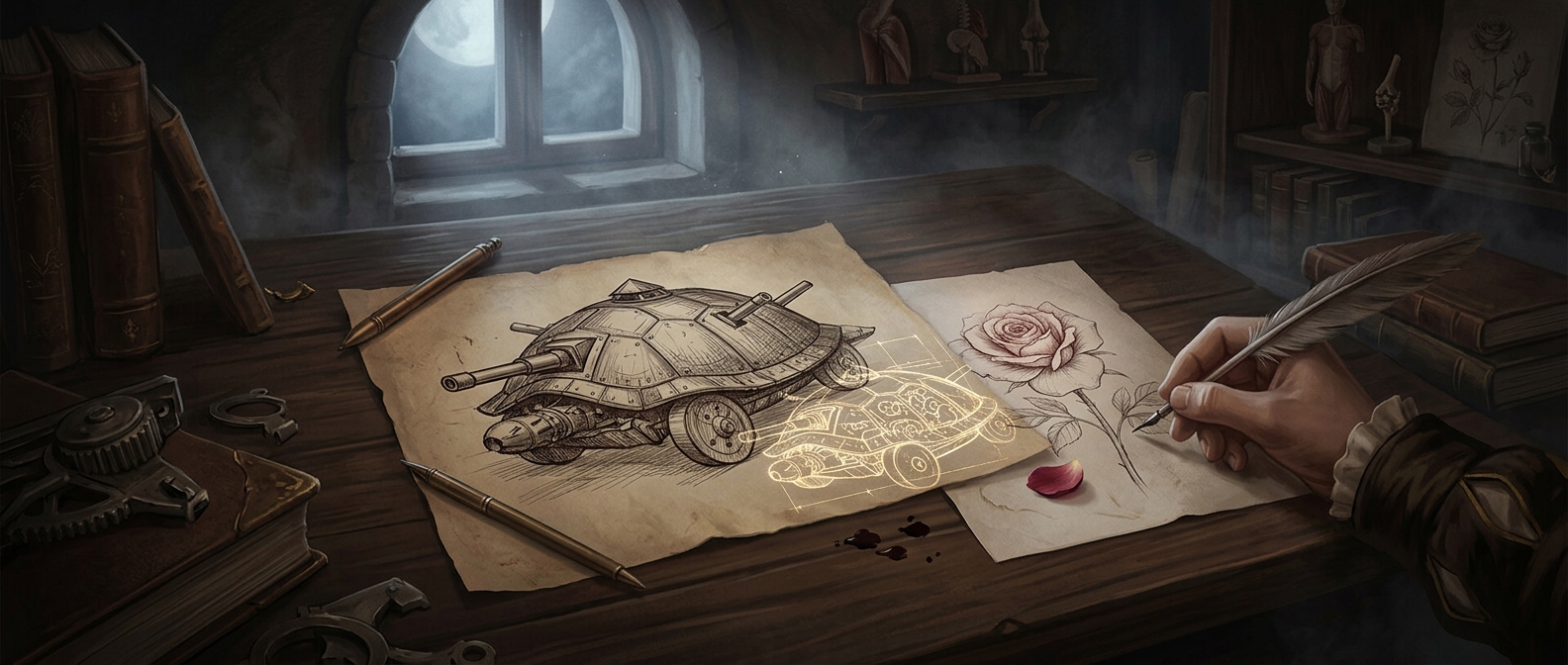
The weapons in his notebooks were not all variations on a familiar device. A giant crossbow enlarged a standard weapon to increase its force and make an imposing display. His multi-barreled gun arranged cannons in rows so one set could fire while another was reloaded—a way to reduce the pause between volleys. The armored vehicle, often described as a tank, was conceived as a protected platform carrying weapons and moving across the battlefield.
Each design began with a real military challenge: how to strike harder, keep firing, or advance under protection. Leonardo’s drawings treated those challenges as problems of structure and motion, not just as opportunities for dramatic shapes.
A design on paper was not a weapon in the field
The notebooks record proposals and experiments, not proof that these machines were built or used in battle. Turning a drawing into working equipment required materials, skilled labor, reliable power, and testing. Some of Leonardo’s concepts were too cumbersome or technically difficult for their time; a striking idea could be more useful as evidence of ingenuity than as a practical weapon.
That gap is part of the story. Leonardo’s military sketches reveal a Renaissance engineer trying to make invention valuable to a ruler—and show how far a design could travel on paper before the technology and resources existed to carry it onto a battlefield.