Why the headset needed an overhead support
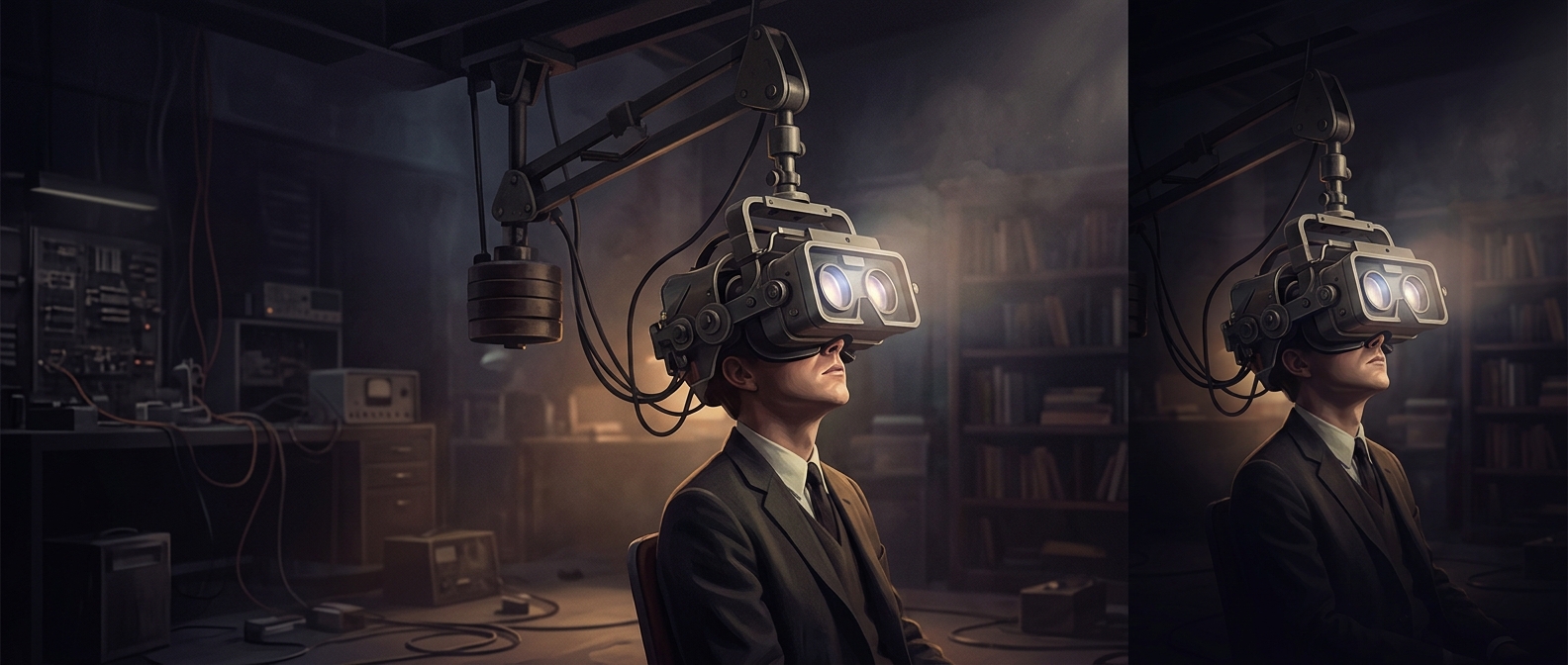
The Sword of Damocles was not a self-contained pair of goggles. Its display components and tracking hardware made the headpiece too cumbersome to hold comfortably, so a mechanical arm suspended it from above. The support took the weight while still allowing the apparatus to follow the wearer’s head—a practical compromise that made an early immersive display usable at all.
That arrangement also reveals a basic engineering problem in virtual reality: a display must stay aligned with a person’s eyes while responding to their movement. If the image does not shift with the viewer’s changing position, the virtual scene feels less like a place the viewer occupies and more like a picture moving in front of them.
Making a wireframe feel spatial
The system showed simple computer-drawn lines rather than detailed images. Its tracking mechanism supplied information about the wearer’s head position and orientation, letting the computer adjust the view as the wearer looked around. The wireframe rooms could therefore appear to occupy space, even though their sparse outlines offered little visual detail.
The ceiling arm was part of the experiment’s interface, not just an awkward stand. It helped connect a person’s physical movement to a changing computer-generated viewpoint. The central challenge was already recognizable: make the view move as the viewer moves, while keeping the display steady in front of the eyes.