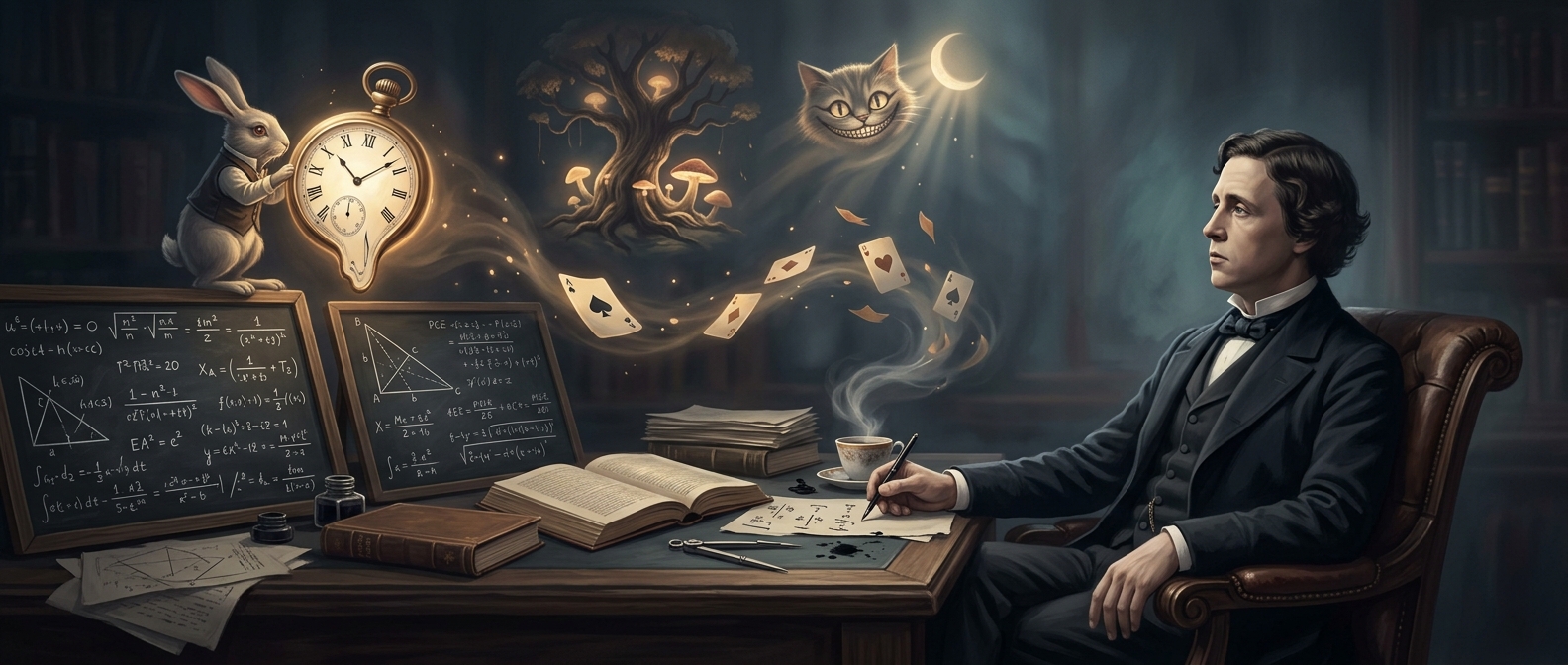
A double life at Oxford
The author known as Lewis Carroll was Charles Lutwidge Dodgson, a mathematics lecturer at Christ Church, Oxford. His academic work included geometry, algebra, and logic—the study of how arguments fit together. “Lewis Carroll” was the pen name he used for his fiction, keeping his literary identity distinct from his university career.
That separation makes the contrast especially vivid: the same person who worked with formal rules also built stories in which rules seemed to wobble. In Wonderland, words shift meaning, arguments run in circles, and familiar ideas are pushed until they become absurd.
From spoken story to book
Wonderland began not as a mathematics project but as a tale Dodgson told Alice Liddell and her sisters during a boating outing in 1862. Alice asked him to write it down. He expanded the story into a manuscript, Alice’s Adventures Under Ground, and later revised it for publication as Alice’s Adventures in Wonderland in 1865.
The book’s nonsense is not simply the absence of order. Its scenes often start with a recognizable rule—a conversation, a lesson, a game—and then apply that rule in a way that exposes its oddness. A question may be treated as if it has a literal answer; a game may keep changing its conditions. The comedy comes from watching tidy systems fail when their assumptions are taken too far.
Why the contrast still catches readers
Dodgson’s mathematical career does not prove that his fiction was secretly encoded mathematics. The stronger connection is in the pleasure both can offer: following a line of reasoning, noticing where it breaks, and testing what happens next. Wonderland turns that pleasure into a story, making the logic itself part of the joke.