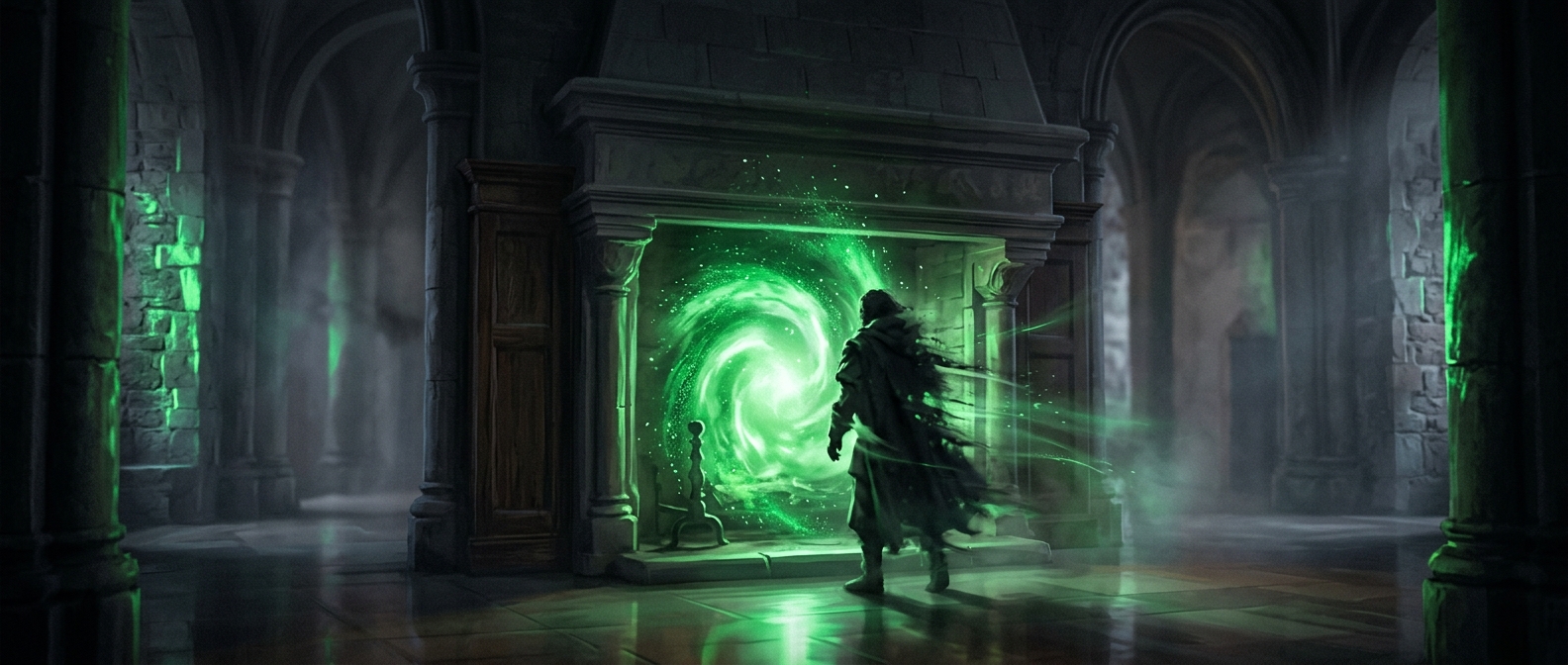
A fireplace becomes a route, not just a doorway
The Floo Network treats participating hearths like stations on a shared transit system. The powder initiates the journey, but the spoken destination does the routing: a traveler has to make the name clear while moving through the flames. That turns an ordinary household fixture into a point of access to a much larger magical network.
The setup also makes travel depend on infrastructure. A fireplace must be connected to the network to serve as an entrance or exit; having a fire alone is not enough. Unlike a journey that begins and ends anywhere, Floo travel funnels people through designated hearths, where arrivals can be seen and where a badly spoken destination can send someone somewhere unintended.
Why the rules are so physical
The method is designed around a body passing through a narrow opening. Keeping limbs tucked in is practical within the story’s logic: a traveler has to enter the flames cleanly, rather than casually stepping through a full-sized portal. The journey’s awkwardness makes the fireplace feel less like an instant shortcut and more like a cramped vehicle with a precise boarding procedure.
That constraint gives the network its distinctive tradeoff. It offers convenient travel between connected homes and public places, but only along routes the system can reach—and every trip requires a suitable hearth and a clearly named destination. The chimney is a transit corridor, but the fireplace remains the gate.