Why Two Cabinets Make a Disappearance Feel Complete
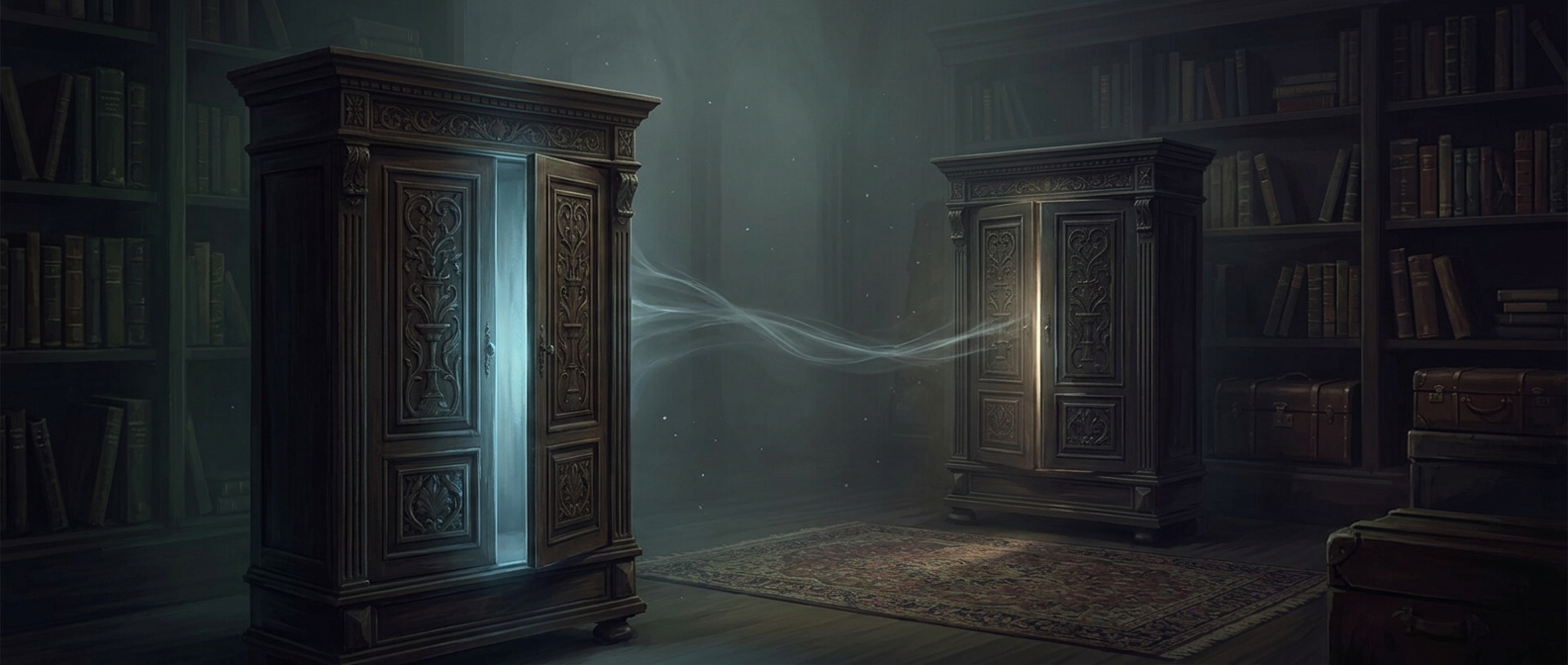
A single cabinet can suggest that someone has vanished, but it cannot show where they went. A matched pair turns the trick into a small, readable journey: the performer is associated with one cabinet, disappears from it, and is then associated with the other. The audience sees a beginning and an ending, so the gap between them can feel like teleportation.
The Audience Connects the Two Moments
The cabinets do not need to prove that a person traveled through space. They need to make each moment convincing enough for the audience to link them. Matching props help: because the cabinets look alike, the second one reads as the counterpart of the first rather than as an unrelated object. The performer’s appearance there supplies the apparent destination.
What happens inside the cabinets depends on the particular illusion; the props are part of stagecraft, not transportation devices. Their job is to frame what the audience can see while the performance directs attention from one side of the stage to the other. The crucial event—the transition itself—is not shown. Viewers infer it from the two visible endpoints.
That makes the pair more than a set of containers. One establishes the disappearance; the other gives it somewhere to go.