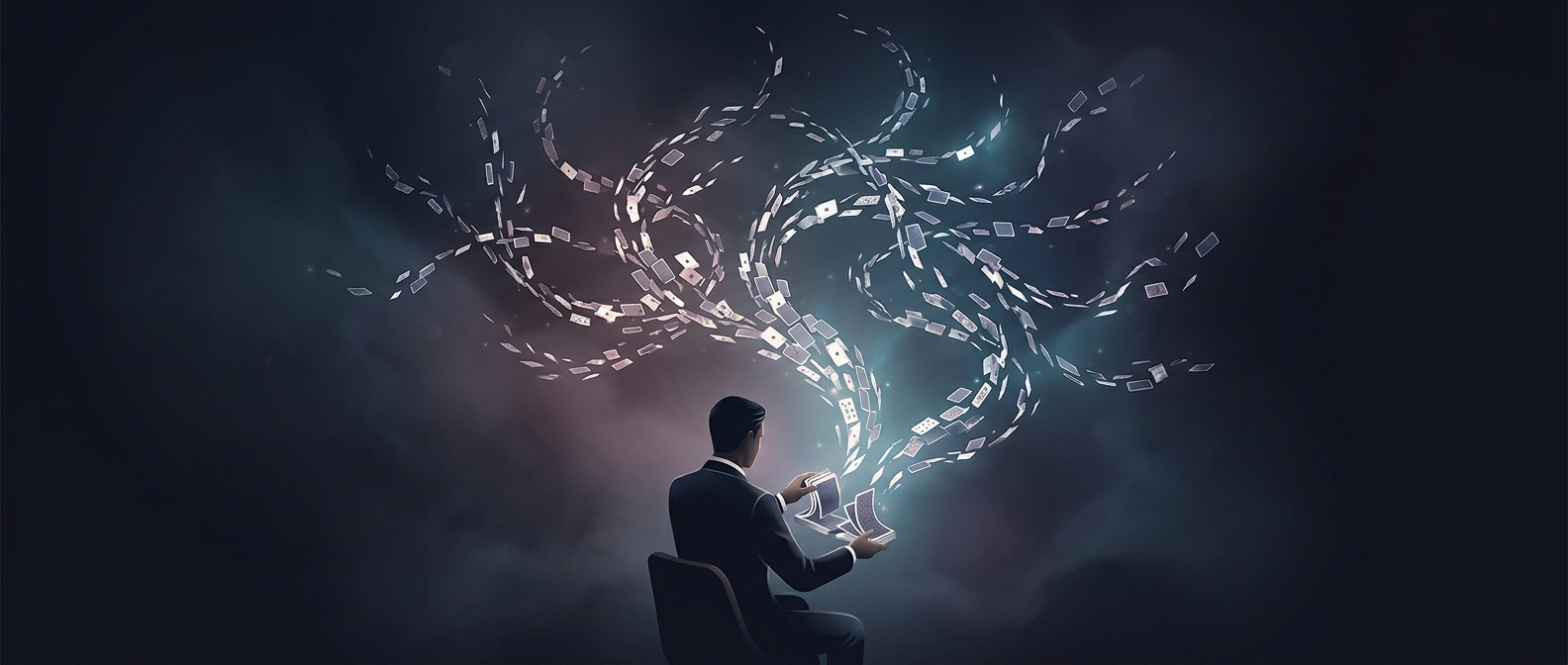
Why a deck has so many possible orders
A 52-card deck can be arranged in 52! different orders. The exclamation mark means “factorial”: multiply 52 by 51, then by 50, continuing down to 1. The first card has 52 possible choices; once it is chosen, the next has 51, and each choice narrows the options for the cards that follow.
The result is about 8 followed by 67 zeroes. That number is so large that even if people had been shuffling cards constantly for centuries, the number of shuffles would be tiny beside the number of possible arrangements.
What “shuffled” has to mean
The math assumes each possible order is equally likely. Real hands are not perfect randomizers: a few casual mixing motions can leave cards clumped or in predictable patterns. A thorough shuffle makes the order much harder to predict, though no ordinary shuffle guarantees perfect randomness.
If the deck is well mixed, the chance that its order matches one particular previous order is roughly one in 52!. That is why a freshly shuffled deck is overwhelmingly likely to produce an arrangement no one has seen before—not because uniqueness can be checked against a record of every deck, but because the number of possibilities dwarfs the number of opportunities to repeat one.
A fleeting arrangement
The cards do not have to stay in that order for long. Deal a hand, play a round, or start Solitaire, and the deck is rearranged. Its remarkable order may be brief, but for that moment the cards occupy one position in a space of possibilities too vast for human history to come close to exploring.