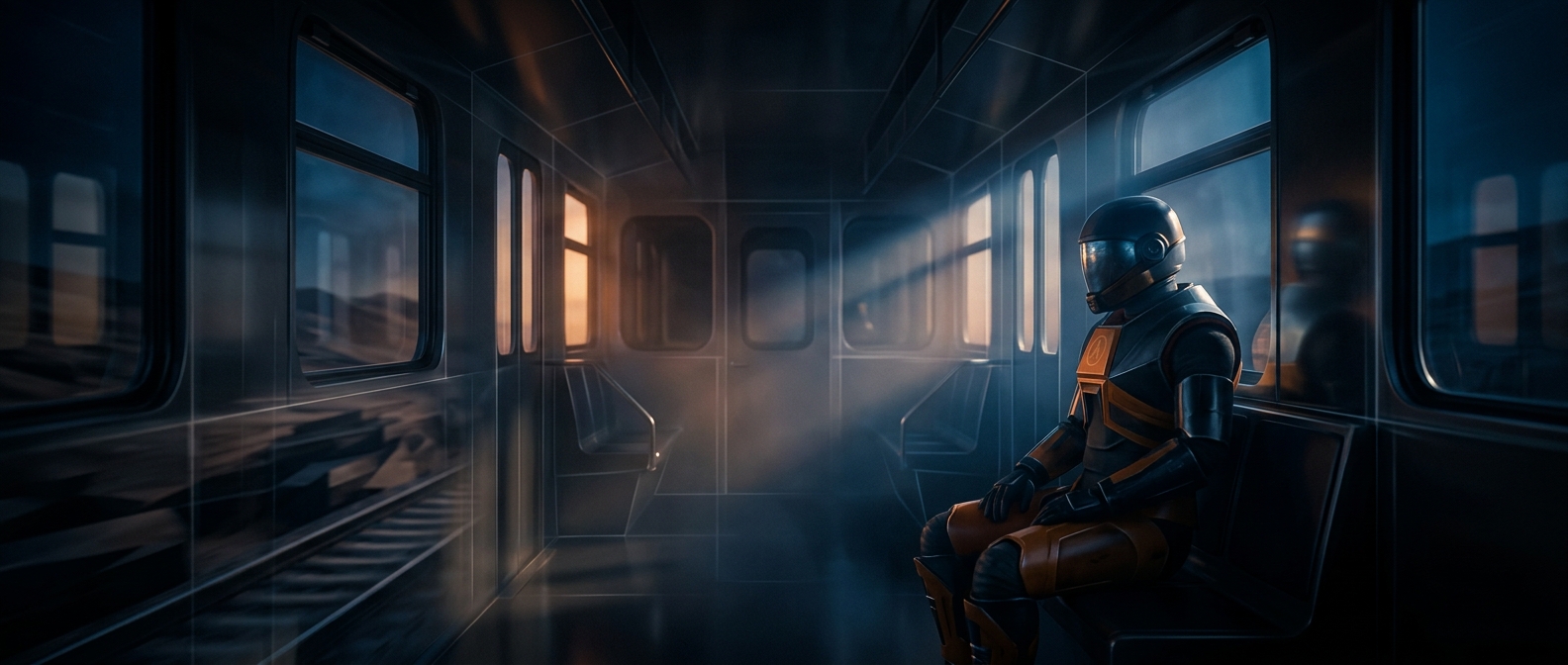
A moving train, built around a stationary player
In Half-Life’s opening ride, Gordon Freeman seems to travel through the Black Mesa research facility aboard a tram. Underneath that illusion, however, the game keeps him in an invisible box and moves the surrounding world in the opposite direction. What matters to the player is the changing view: walls, lights, and other scenery slide past the windows, making the tram feel as if it is carrying Gordon forward.
This is a classic trick of perspective. Motion is relative: if the passenger stays still while the surroundings move backward, the visual result can resemble forward travel. The invisible box gives the game a stable place to keep Gordon while the scene around him creates the journey.
Why stage the ride this way?
The engine was not able to move a player character inside a vehicle, so the developers could not simply put Gordon in a moving tram and carry him along. Reversing the apparent motion worked around that limitation without asking the player to do anything. The ride could unfold as a controlled introduction, with the facility gradually coming into view while Gordon remained in a predictable position.
That choice also suits the scene’s purpose: the player is not yet steering or exploring freely. The tram ride lets the game show Black Mesa before the action begins, while maintaining the impression that Gordon is being transported through it.
The useful illusion
The trick works because a player judges motion from visible change, not from the character’s position in the game’s underlying space. A stationary passenger and a moving backdrop can tell the same story as a moving passenger and a stationary backdrop. In Half-Life, that small technical workaround turns an engine limitation into a guided journey through the world.