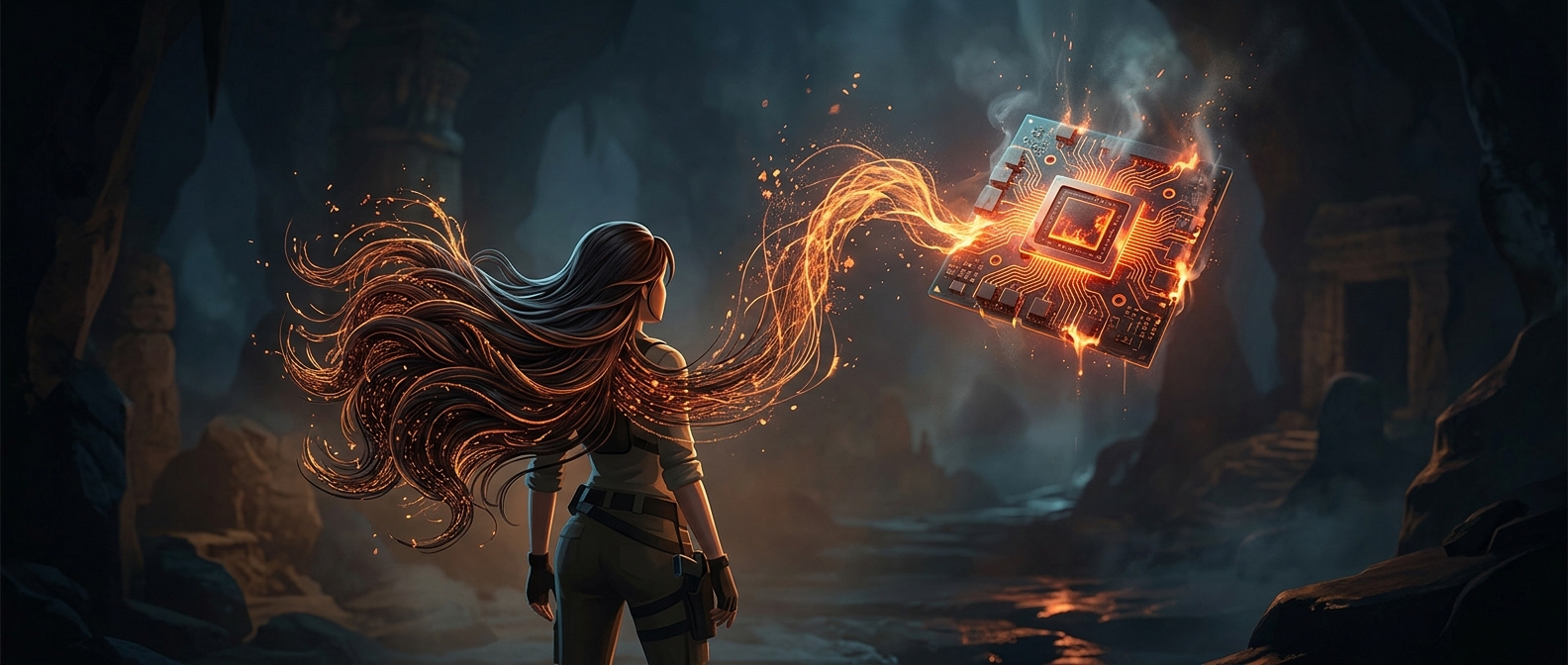
Why Lara Croft’s ponytail was so expensive to render
A conventional game hairstyle is often built from a few broad shapes or textured strips. That keeps the workload manageable, but the hair can look more like a solid helmet than separate strands. TressFX took a more demanding approach: it represented Lara’s hair as many individual strands, then animated them so they could bend and sway with her movement and the surrounding forces.
That realism came from doing the work repeatedly, not just drawing a detailed ponytail once. The game had to update the strands’ positions as Lara moved, then render their fine, overlapping shapes in each frame. Those calculations competed with everything else the graphics card needed to draw, including the character, environment, lighting, and effects.
A feature with a steep hardware threshold
The cost mattered because games have to produce new frames quickly and consistently. When a graphics card cannot finish the hair simulation and the rest of the scene in time, the game’s frame rate drops: motion looks less smooth, and controls can feel less responsive. The effect was especially noticeable on PCs without high-end graphics cards, where the hair could consume resources that the rest of the game needed.
TressFX therefore exposed a familiar design tradeoff: more detailed simulation can make a character feel more physically present, but it also narrows the range of hardware that can deliver that detail smoothly. Lara’s ponytail was not merely a cosmetic flourish; it was a real-time workload added to every frame. For players with powerful cards, strands could ripple convincingly as she moved. For others, that same attempt at realism could bring the whole game’s performance down.