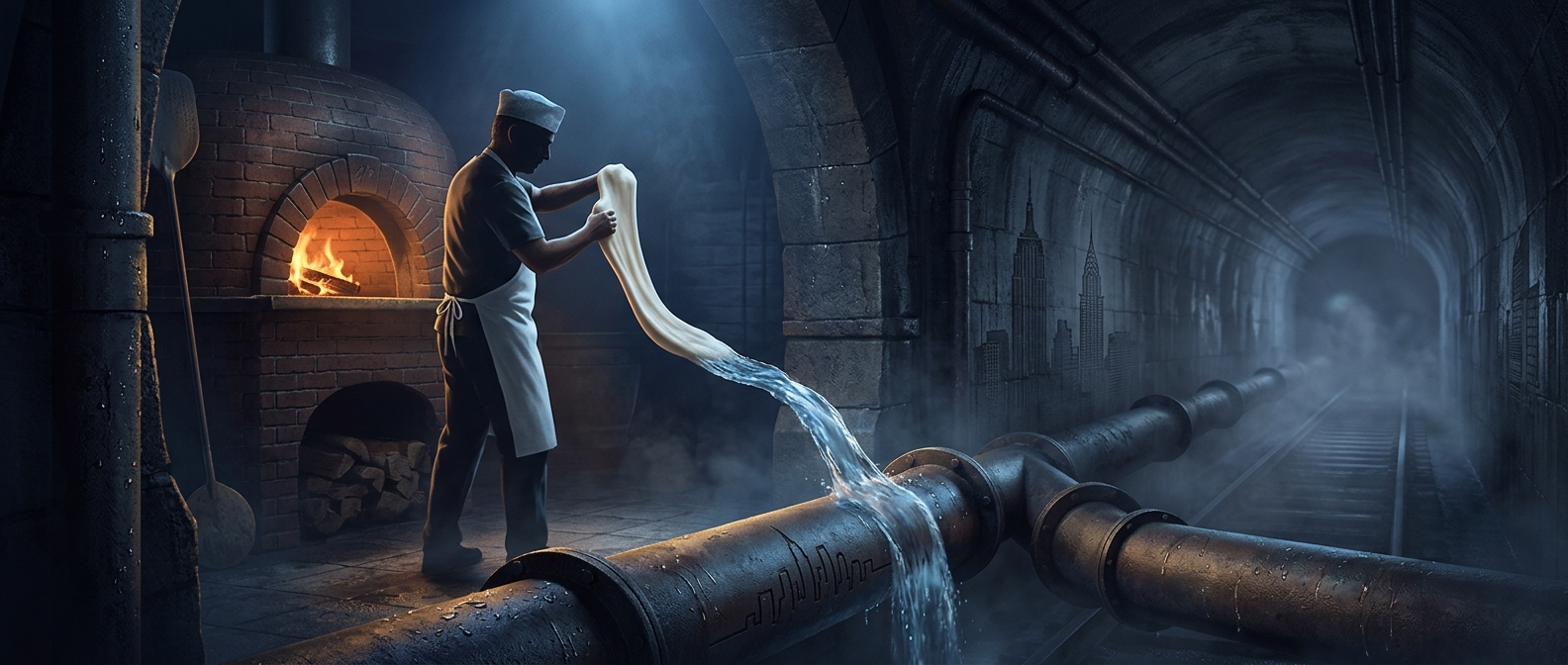
What water can—and can’t—do to pizza dough
Water is a major ingredient in dough, but it doesn’t act alone. Its minerals can affect how flour proteins behave as they hydrate and form gluten, the stretchy network that gives dough structure. That network helps a crust hold gas as it rises and contributes to the springy, chewy bite associated with a New York slice.
The effect is real but subtle. Flour, fermentation time, mixing, and oven heat all shape the finished crust, so tap water by itself cannot guarantee a particular texture.
A city’s water, carried into the pizzeria
New York City’s drinking water comes largely from protected reservoirs and travels through a long system of aqueducts and pipes before reaching taps. Its mineral profile is relatively low in dissolved minerals compared with hard water in many places. That consistency gives local bakers a familiar starting point: the water behaves much as they expect from batch to batch.
For a pizzeria, familiar water can make dough easier to reproduce, especially when recipes and methods have been refined around it. But a shop elsewhere can adjust its water and dough process; the city’s tap is not a secret ingredient that cannot be copied.
The bite comes from the whole method
A New York-style slice’s chew is better understood as the result of a system: the flour and its gluten-forming proteins, how the dough is mixed and fermented, how thinly it is stretched, and how quickly it bakes. Water is part of that system because it helps bring the ingredients together and influences dough handling—not because it single-handedly creates the city’s signature crust.
That is why the tap-water story persists: it points to a real local ingredient, while the memorable bite is built by everything the pizzeria does with it.