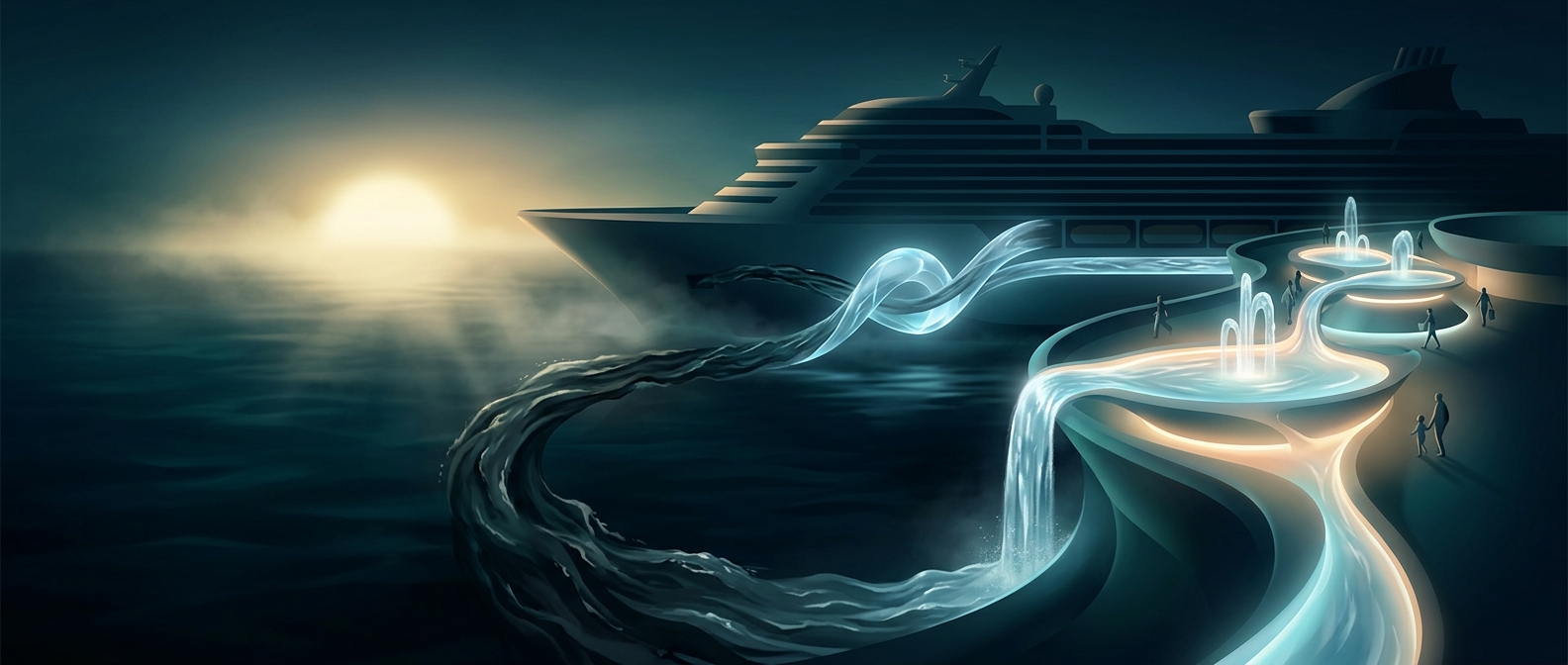
Making Fresh Water Without a Shoreline
A cruise ship cannot rely on municipal pipes once it leaves port, yet guests and crew need water for drinking, cooking, showers, laundry, and cleaning. Carrying every drop for a voyage would take up valuable space and add substantial weight, so many ships make much of their own water from the sea.
Two Ways to Separate Salt
In reverse osmosis, pumps force seawater against a membrane: a thin barrier whose tiny openings let water molecules pass while holding back most dissolved salts and other particles. The pressure must be high because seawater naturally pushes back against the membrane. The water that crosses is collected as fresh product water; the concentrated, saltier remainder is returned to the sea.
The other approach uses heat. In a distillation system, seawater is warmed until some of it evaporates. Salt does not travel with the vapor, so when that vapor is cooled and condenses, it becomes low-salt water. The leftover brine—the concentrated saltwater—must still be discharged or otherwise managed.
The Ship’s Energy Tradeoff
Both methods require energy, but they use it differently. Reverse osmosis depends on powerful pumps; distillation depends on heat and cooling. A ship’s engineers choose and operate equipment around the vessel’s available energy and heat, its water demand, and the conditions of the seawater. In either case, the separation is only part of the job: the resulting water is checked and treated as needed before it is suitable for onboard use.
The practical payoff is independence from shore-based water supplies. The ocean can serve as the ship’s source, but not as a ready-made tank: the vessel must spend energy to separate usable water from salt and handle the concentrated residue left behind.