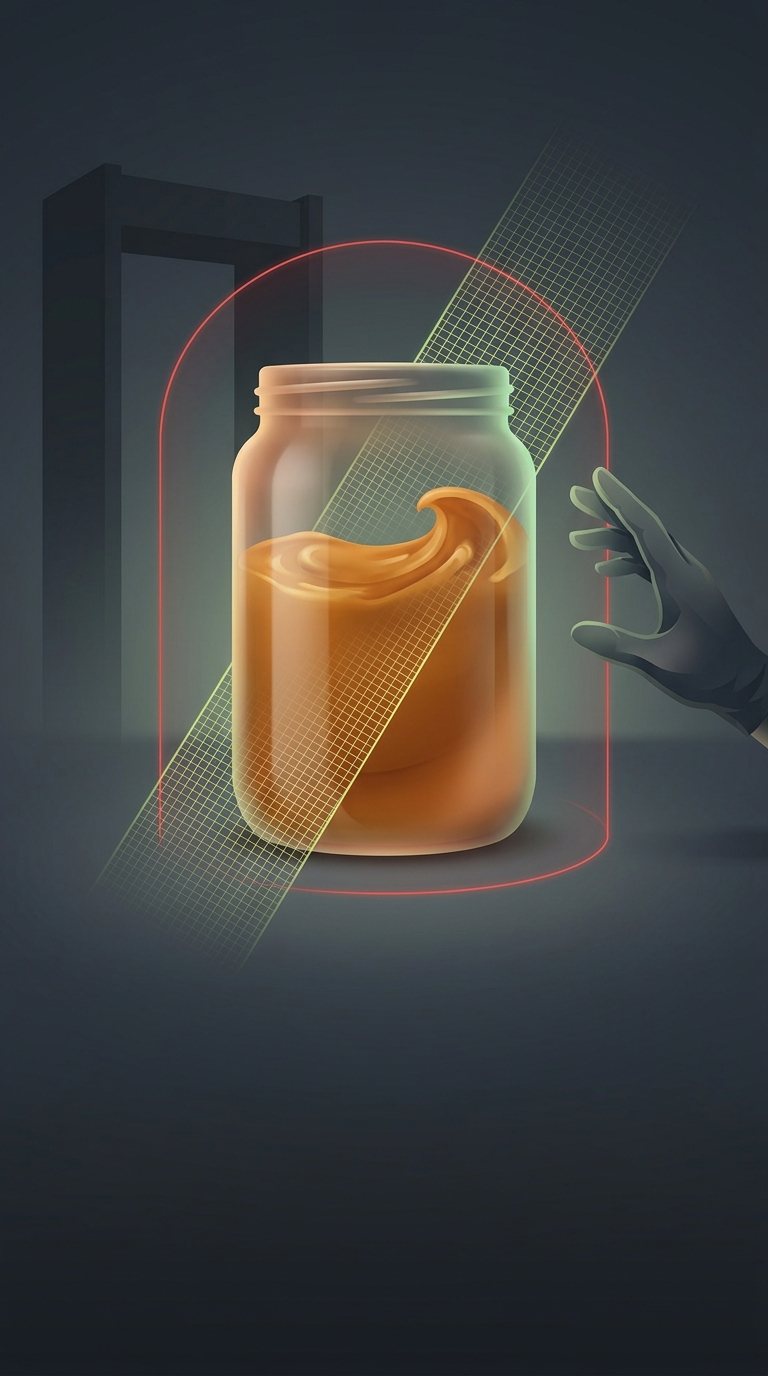
Why Peanut Butter Counts as a Liquid at Security
At airport screening, the key question is not whether a food seems solid on a sandwich. It is whether it can be spread, poured, or otherwise behave like a liquid or gel. Creamy peanut butter fits that category, so a large jar is subject to the carry-on limits for liquids and gels—even though it holds its shape in the pantry.
That classification is part of a screening rule designed around containers of substances that could be difficult to assess quickly. Rather than decide whether each unfamiliar paste is “solid enough,” screeners apply a broad category to spreads, gels, and similar materials. The rule concerns how much you may bring through security, not a claim that peanut butter itself is dangerous.
The Container Makes the Difference
In a carry-on, peanut butter must meet the same small-container limit as other restricted liquids and gels: each container can hold no more than 3.4 ounces (100 milliliters), and it must fit in the quart-size liquids bag. A full-size jar generally needs to go in checked luggage. The limit applies to the jar’s capacity, not just the amount left inside it.
That is why a traveler can bring a peanut-butter sandwich through screening but lose a larger jar packed alongside it. The sandwich is treated as food; the spread in its container is screened under the liquids-and-gels rule. For a spreadable food, the simplest way to avoid a surprise at the checkpoint is to pack the jar in checked baggage or choose a travel-size container that meets the carry-on limit.