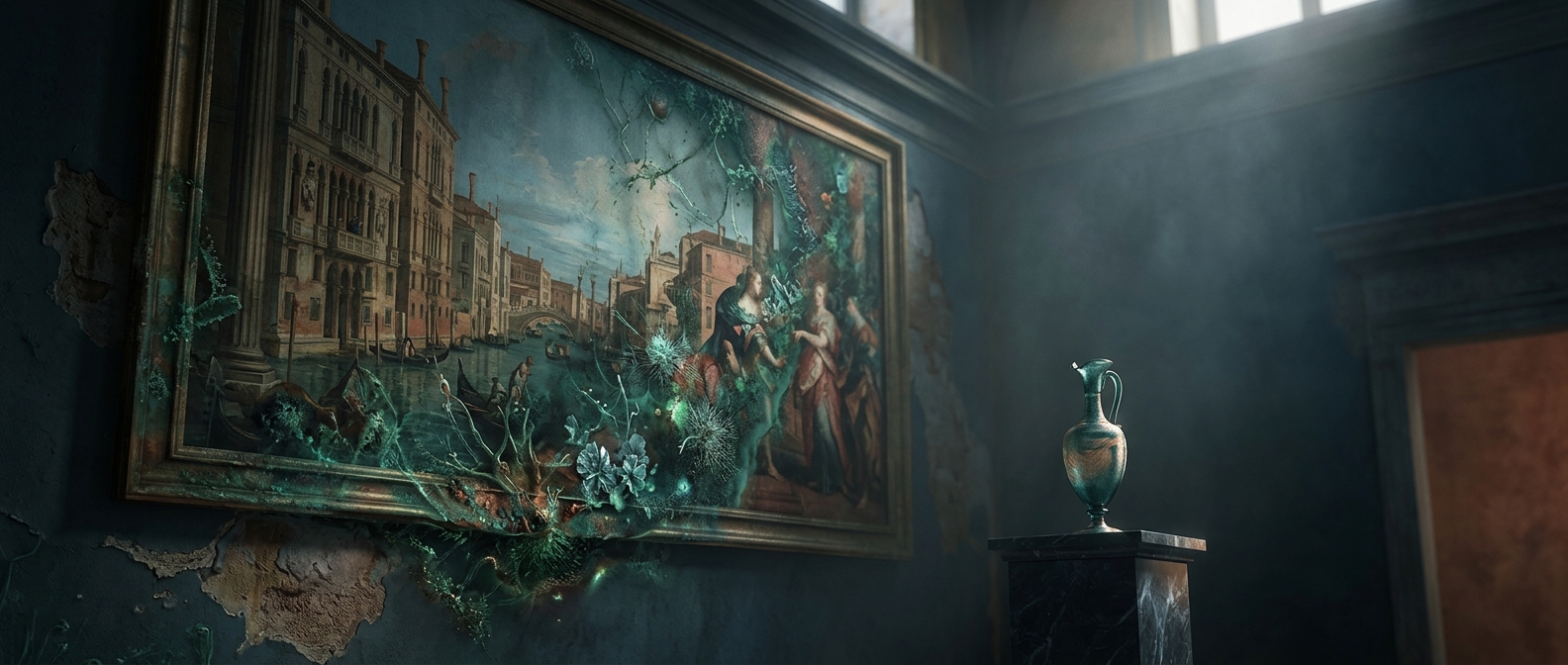
How a living film can change stone
A dark or greenish coating on a Venetian wall may look like ordinary grime, but it can contain communities of bacteria, fungi, algae, and other microscopic organisms. Together with the substances they produce, these organisms form a biofilm: a thin, often sticky layer attached to a surface.
The film can hold moisture against stone and glass. That matters in a city exposed to damp air and frequent wetting: water helps microbes remain active and can carry dissolved substances into tiny pores and cracks.
From growth to gradual damage
Microbes do not simply sit on top of the surface. Their metabolism—the chemical reactions that keep them alive—can produce acids and other compounds. Those substances may react with minerals in stone, dissolving or transforming some of the material. Organisms and their films can also trap particles, and repeated cycles of wetting and drying can stress a fragile surface.
The effects vary with the material and the organisms involved. A coating on one kind of stone may mainly discolor it; on another, biological activity and retained moisture may contribute to loss of the outer surface. Glass does not weather in the same way as stone, but films can still cling to it and alter its appearance.
Why cleaning is not a simple fix
Because the film is attached and biologically active, removing its visible color does not necessarily undo the chemical changes already made. Aggressive scrubbing or treatments can damage the historic surface too, while a cleaned area may be recolonized if damp conditions persist. Conservators therefore have to weigh the harm from the living layer against the risks of intervention, rather than treating every mark as dirt.
The consequence is easy to miss: a thin film can be both a visible stain and an ongoing interaction with the material beneath it. On fragile historic stone, even slow changes matter because they accumulate over time.