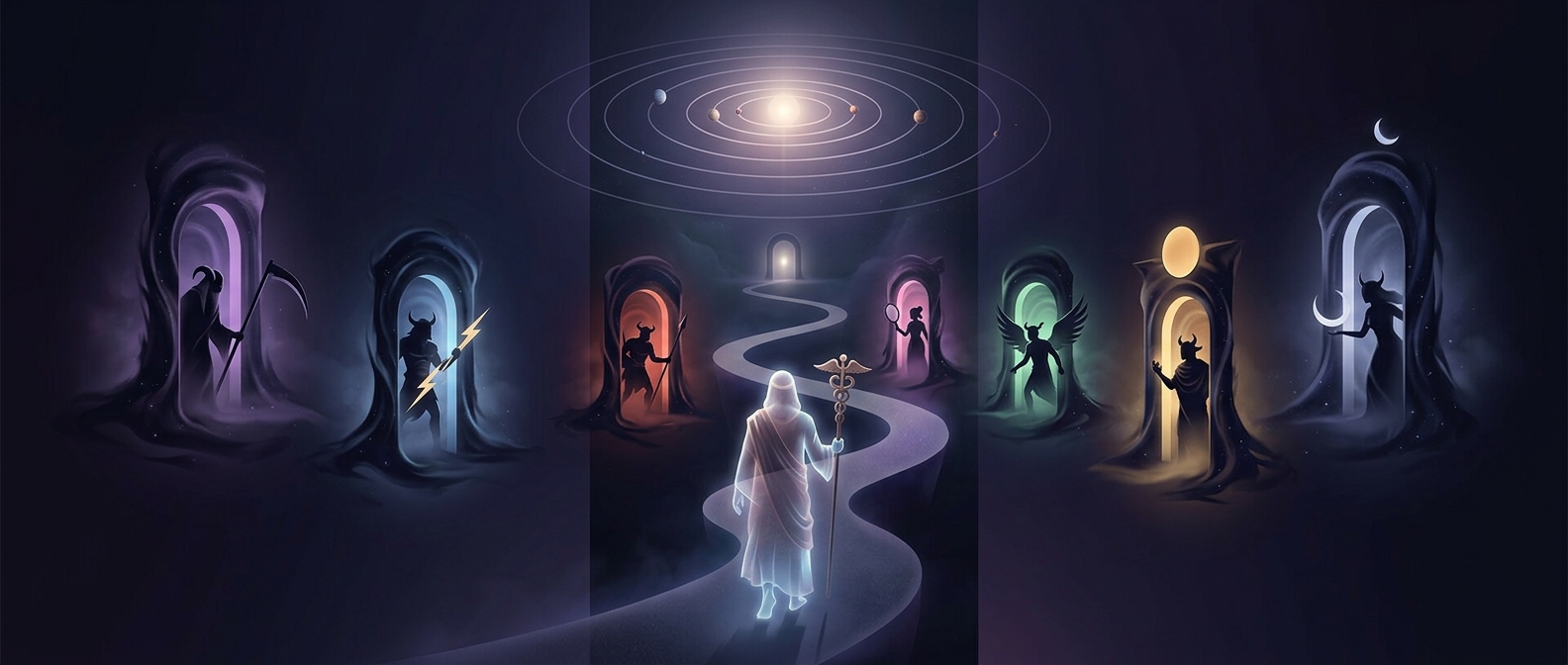
The soul’s ascent through the planets in Hermetic thought
In the first treatise of the Corpus Hermeticum, a dialogue known as Poimandres, the soul’s journey after death is described as a passage upward through seven planetary regions. These are not simply places in the sky: in ancient cosmology, the planets were thought to shape forces and traits in earthly life. The ascent imagines the soul leaving those influences behind, one sphere at a time.
What the soul sheds on the way
At each level, the soul gives back a corresponding influence. The text names traits such as desire, arrogance, anger, and greed among what is relinquished. This is less like paying a demon a toll than stripping away the habits and impulses that bind a person to life under the planets. The spheres mark stages in that release, not seven monsters guarding a literal checkpoint.
The imagery reflects a world in which astrology and cosmology were closely connected: the planets were part of an ordered universe whose powers reached down into human affairs. To rise beyond them was to move beyond the conditions that had shaped ordinary, embodied existence.
Beyond the planetary order
Once the soul has passed through all seven spheres, the account says, it reaches a higher divine realm and joins in praise with other souls. The destination is often described as the divine intellect—the realm of divine understanding—rather than another physical location in the sky.
The journey’s point is therefore not escape from a set of evil guards. It is transformation: death begins a process in which the soul is imagined as shedding planetary influences until it can approach the divine without them. The memorable detail is the sequence itself: the soul does not simply fly upward, but leaves behind, layer by layer, what once made it part of the world below.