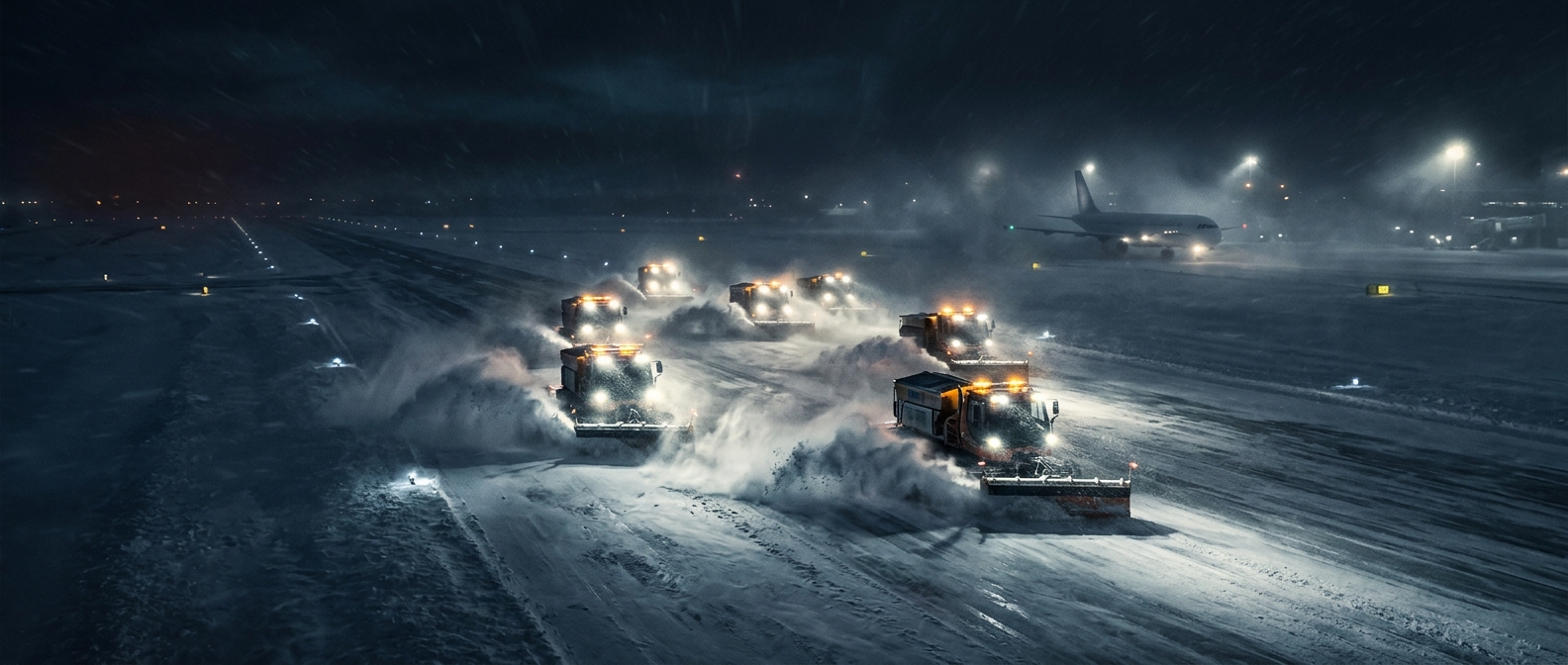
Why a runway can be cleared in one coordinated sweep
A runway is too long for a single plow to clear quickly by itself. If vehicles worked one after another, each would cover only a narrow strip, and the line of equipment would need repeated trips to reach the full width. A coordinated formation changes the geometry: several plows travel along the runway at once, each responsible for a different lane.
The vehicles are staggered so their blades push snow outward without leaving broad ridges between cleared strips. The outer plows carry snow toward the runway edges, while the others clear the pavement between them. Their spacing and pace have to stay coordinated; a gap can leave a strip behind, while poor alignment can pile snow where another plow is supposed to pass.
Clearing snow is only part of reopening
Moving snow off the pavement does not, by itself, establish that the runway is ready for aircraft. Airport crews also need to assess the remaining surface—especially whether packed snow or ice affects how much grip aircraft tires can get during landing and takeoff. That check matters because a runway can look clear while still offering less braking traction than expected.
The sweep saves time by removing a large share of the snow in parallel rather than in successive passes. It also concentrates equipment and effort during a disruption, allowing crews to clear the surface and then evaluate it as a single operational task. The speed comes not from one exceptionally powerful machine, but from many machines covering the runway together.